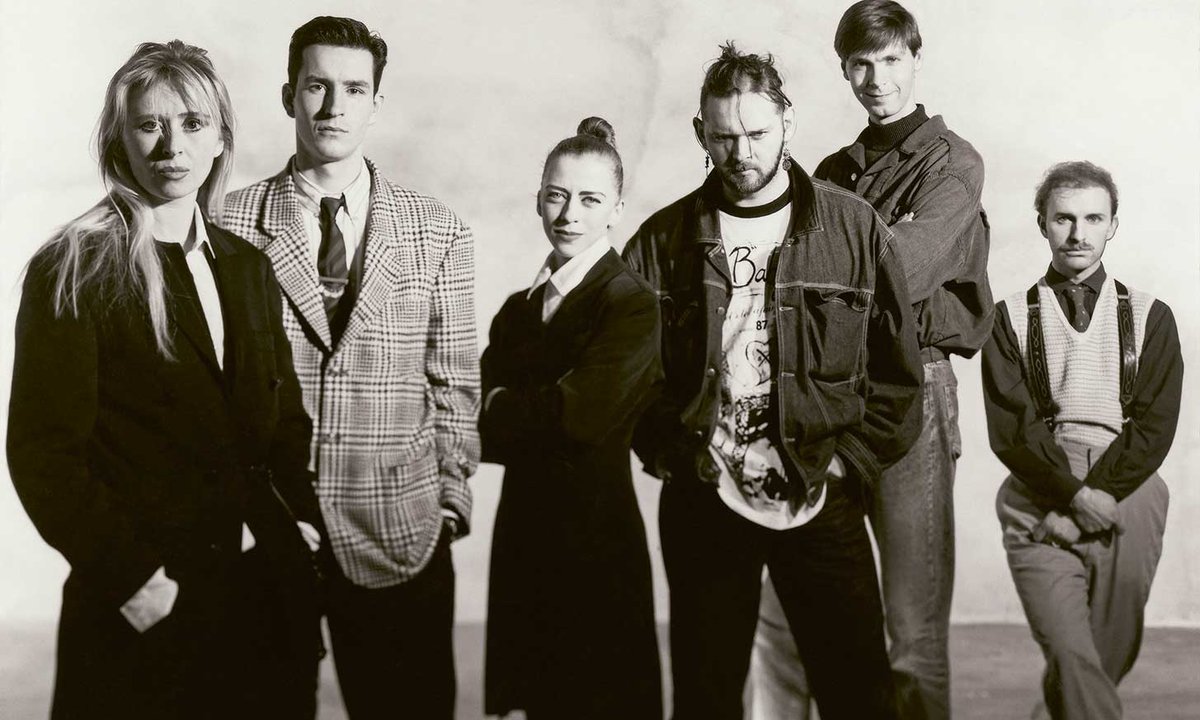
I had probably the most joyous cultural experiences of my life in March. David Byrne, the previous Speaking Heads frontman, is touring with a present that options work from 50 years of songwriting whereas additionally reflecting his immersion in artforms together with modern dance, and movie and video set up. Byrne and his firm’s thrill at presenting the fabric is so infectious that critics and audiences have greeted it with common rapture.
And the singer is deeply invested on this emotion. In 2018, he based a nonprofit, Arbutus, whose purpose is “making certain that our image of the world incorporates the enjoyment that it ought to”, notably by way of the net journal Causes to be Cheerful, a “tonic for tumultuous instances”. This isn’t blinkered, idle positivity however investigative journalism that explores sensible considering and options to urgent points. Certainly, I noticed Byrne at a second when the world’s points appeared as urgent—and the instances as tumultuous—as ever, with the escalation of conflict within the Center East. It’s notable, although, that the euphoria which sweeps us together with Byrne in his present is a type of resistance: his efficiency contains, amongst a lot else, pictures of US immigration brokers’ brutality and people who protest it.
Nonetheless reeling from Byrne’s live performance, I noticed two exhibitions that additionally addressed artwork’s capability for pleasure as activism. David Hockney’s present at London’s Serpentine North, A Yr in Normandie and Some Different Ideas About Portray, is accompanied by a quote from the artist through which he acknowledges “an unlimited quantity of struggling” and states that he feels his “obligation as an artist is to beat and alleviate the sterility of despair”. Hockney’s conviction is embodied in his work’s exuberance and effervescence.
A queer pioneer
One other present London present counters despair with pleasure with explicit vividness and poignancy. Catherine Opie’s three-decade portrait survey, To Be Seen, working on the Nationwide Portrait Gallery, exemplifies her conviction that “with out illustration there isn’t any visibility”. She made portraits of the leather-based dyke group round her in Los Angeles in Being and Having (1991), certainly one of her breakthrough collection, as a result of, as she has stated, she felt that “I didn’t see myself represented in wider tradition or society”. And that undertaking transmits pleasure: towards a vibrant yellow background, Opie presents her lesbian pals and herself—by way of her male-presenting alter ego Bo—in excessive close-up, severely cropped. All of them don clearly pretend facial hair. The environment of the pictures, articulated each within the moustaches and beards and within the tight framing and Pop color, is certainly one of defiance but additionally play.
Even in essentially the most arresting and unsettling picture within the present, Self-Portrait/Slicing (1993), Opie finds surprising levity amid despair. We see the artist’s naked again, onto which a picture is inscribed with a blade: two stick figures, whose triangle skirts inform us that they’re girls, with a home and a solar showing behind a cloud. Blood is swelling into drips that can quickly run down her again.
Opie had simply been by means of a breakup. As Shaun Caley Regen, Opie’s Los Angeles gallerist, has stated, it’s a picture of longing, a seemingly unattainable very best of queer domesticity amid a homophobic world. It was additionally confronting its viewers with the ethical panic about homosexual life and blood within the Aids disaster.
However, as Opie instructed me on the A brush with… podcast, within the {photograph} she positioned herself towards the patterned wallpaper, a transparent nod to the backgrounds in historic work, so {that a} basket of fruit sits above her. “There’s a Carmen Miranda second,” she stated. “There’s humour inside that too… I might need had a damaged coronary heart and my pals have been dying of Aids, however I made a decision to choose a material that had an enormous fruit basket over my head.” A defiant queerness is, as she stated, “embedded inside that imagery”.
Opie confronts prejudice
Opie’s exhibition is filled with completely judged sightlines. Reverse Self-Portrait/Slicing, on the finish of an extended, slender house, is one other picture of herself. In Self-Portrait/Nursing (2004), she breastfeeds her son Oliver, having lastly achieved the happiness she has craved. On her chest, above his head, we see the ghostly hint of one other painful inscription, the place she had had “pervert” written on her chest by a physique modifier. This was for one more piece, Self-Portrait/Pervert (1994), through which she additionally wore a leather-based BDSM hood.
That piece confronted societal marginalisation and prejudice in brutal, nonetheless stunning phrases. However its presence as a hint in an in any other case celebratory picture of Opie’s motherhood is exquisitely touching. She proves that within the unflinching confrontation of situations that in any other case may immediate despair, anart of pleasure might be born.
• Catherine Opie: To Be Seen, Nationwide Portrait Gallery, London, till 31 Could