The Museum of Up to date Artwork (Moca) in Los Angeles has acquired Unmanned Drone (2023), a towering bronze sculpture the US artist Kara Walker made by dissecting and reassembling a decommissioned statue of the Accomplice normal Thomas Jonathan “Stonewall” Jackson. The 1921 monument, by Charles Keck, was one in every of two Accomplice statues in Charlottesville, Virginia, that have been dismantled following the “Unite the Proper” rally of white nationalists in 2017.
Walker’s sculpture is presently on view on the Los Angeles non-profit house The Brick as a part of Monuments (till 3 Might), an exhibition additionally on show at Moca’s Geffen Up to date location that examines the legacy of Accomplice monuments and options modern artists’ responses to white supremacist iconography and statuary. Kara Walker co-curated the exhibition alongside The Brick’s director Hamza Walker and Moca’s senior curator Bennett Simpson.
Kara Walker, Unmanned Drone, 2023 (element) The Museum of Up to date Artwork, Los Angeles, Buy with funds supplied by Beth Swofford by trade. © Kara Walker. Picture by Fredrik Nilsen.
“With the acquisition of Unmanned Drone, we’re honoured to steward this epic and historic sculpture by Kara Walker,” Moca’s interim director Ann Goldstein mentioned in an announcement. “A searing and essential assertion in regards to the legacy of post-Civil Conflict United States, it’s a profound work for this second—and for the ages.”
In her sculpture, Walker has reworked the strident monument of Jackson driving to battle on his horse Little Sorrel right into a Frankensteinian determine of a Hieronymus Bosch or Giuseppe Arcimboldo portray. Unmanned Drone is a symbolically castrated, damaged jumble of human and horse limbs that appears to concurrently be transferring ahead and retreating.
In a pamphlet accompanying the exhibition at The Brick, Kara Walker tells Hamza Walker (no relation) of the impression of reassembling the monument’s bronze components for her sculpture: “When it began to take form, I used to be like, that is one thing that’s really terrifying to me. It is not simply this benign horse and rider who symbolise these items, however it’s this horror that has been enacted over our shared historical past, and our grandparents’ historical past, our great-grandparents, and our great-greats. It looms.”
Accompanying works by Walker at The Brick embody components of the monument that she has sand-blasted, painted and upended. One other Charlottesville monument, depicting the Accomplice normal Robert E. Lee, that additionally turned a flashpoint for far-right rallies in 2017, has since been eliminated and melted down; its constituent components at the moment are on show at Moca as a part of Monuments.
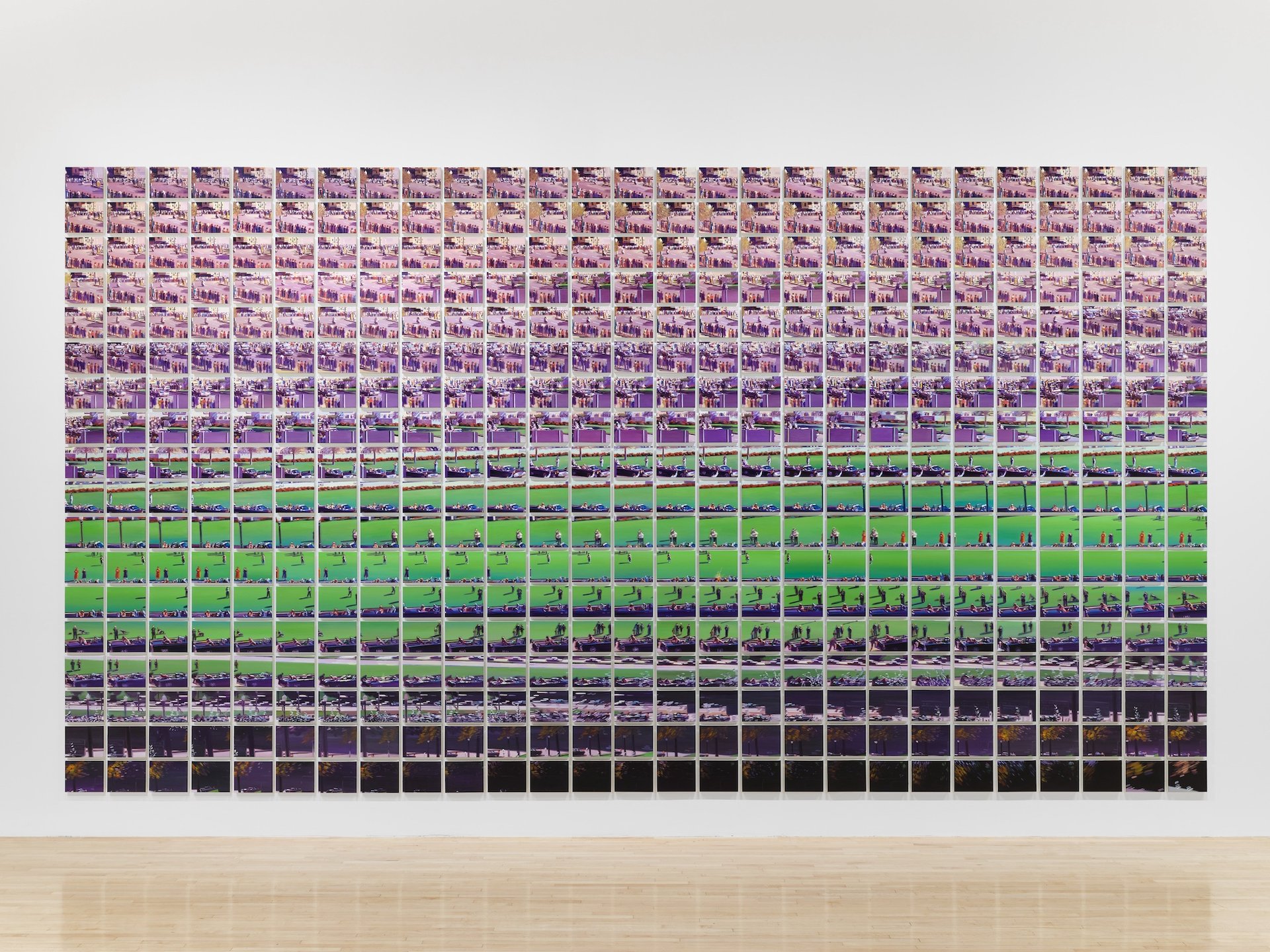
Cynthia Daignault, Twenty-Six Seconds, 2024 The Museum of Up to date Artwork, Los Angeles, Buy with funds supplied by Pete and Michelle Scantland. © Cynthia Daignault. Picture by Jeff McLane
Along with Walker’s Unmanned Drone, Moca has revealed greater than 150 works acquired for its everlasting assortment final yr. They embody Cynthia Daignault’s 486-panel portray Twenty-Six Seconds (2024), which depicts each single body of the notorious footage of John F. Kennedy’s assassination; the monumental set up was included in Moca’s main photorealism exhibition final yr. Additionally becoming a member of the museum’s everlasting assortment is the video Purple Inexperienced Blue (2022) by Paul Pfeiffer, who was the topic of an necessary survey exhibition at Moca in 2023-24.
Different works which have not too long ago joined Moca’s assortment and are being publicly introduced this week embody items by Shizu Saldamando, Takako Yamaguchi, Olafur Eliasson, Henry Taylor, Shizu Saldamando, Meriem Bennani, Suzanne Jackson, Julie Mehretu, Mike Kelley and Nairy Baghramian. In an announcement, Moca’s chief curator and director of curatorial affairs Clara Kim mentioned this cohort of acquisitions “displays a sustained and deeply collaborative effort to suppose critically about what it means to construct a museum assortment within the twenty-first century”.