
Ripple’s UK & Europe coverage director Matthew Osborne is urging central banks to cease treating stablecoins as an exterior risk and as a substitute fold well-regulated issuers into core safeguards, arguing that oversight plus entry to official infrastructure could make stablecoins a internet stabiliser for funds and settlement.
Writing for the Official Financial and Monetary Establishments Discussion board on 19 January 2026, Osborne mentioned stablecoins have moved properly past a distinct segment experiment, citing a market worth “in extra of $300bn” and annual transaction volumes that he wrote now surpass Visa and Mastercard mixed. He argued momentum may speed up within the US after the Genius Act, which he mentioned would introduce federal guidelines and permit banks to subject stablecoins.
The Ripple exec framed the shift as already seen amongst central banks themselves. He pointed to the European Central Financial institution’s latest recognition of stablecoins’ advantages for cross-border funds and its view that tomorrow’s monetary system will host a number of types of cash. He additionally cited the Financial institution of England’s stance that stablecoins may help “quicker, cheaper retail and wholesale funds” as a part of a “multi-money” system underpinned by central financial institution cash.
Ripple Exec: Deliver Stablecoins Into The Security Web
On the centre of his case is the declare that stablecoins must be handled as an incremental evolution quite than an adversarial substitute. “Regulated stablecoins may play a key function in monetary markets alongside different types of cash,” Osborne wrote. “First, stablecoins usually tend to complement the prevailing monetary system than change it. That is evolution, not revolution.” He then added: “The answer lies in central banks channelling stablecoin momentum, not combating it.”
Osborne argues central financial institution cash will stay important as a risk-free settlement asset and protected retailer of worth, however its relative function may shift in digital markets. He pointed to atomic settlement, the place legs of a transaction settle concurrently and conditionally, as lowering the normal want to make use of central financial institution cash purely to mitigate settlement danger.
The place stablecoins could possibly be structurally most well-liked, he wrote, is in cross-border flows and multi-chain markets. “Cross-border funds are one instance, on condition that stablecoins can transfer worth wherever on the earth in seconds,” the Ripple exec mentioned.
“In distinction, central financial institution cash is more likely to be much less appropriate for cross-border funds given entry could also be geographically restricted and adoption of on-chain central financial institution cash is much from common world wide.” He additionally argued stablecoins are more likely to exist throughout extra blockchain networks than central financial institution cash, making same-chain settlement between tokenized property and money extra achievable whereas interoperability stays uneven.
Central banks have repeatedly warned that stablecoins may pull funds from financial institution deposits, weakening financial institution credit score creation and probably amplifying stress occasions. Osborne pushed again, arguing the chance is overstated as a result of markets already accommodate devices backed by extremely liquid property, cash market funds, e-money, and “slender banks”, with out inflicting sustained deposit runs.
His greater level is that regulation, whereas needed, is inadequate with out a backstop. “However regulation alone just isn’t sufficient,” Osborne wrote. “Stablecoin issuers lack entry to the security internet that offers financial institution deposits their resilience. With out it, even well-managed stablecoins are extra susceptible to shocks – as seen when USDC briefly misplaced its peg following publicity to Silicon Valley Financial institution in 2023.”
He argued central banks ought to contemplate extending components of that security internet, together with permitting well-regulated stablecoin issuers to carry a part of their backing property in central financial institution accounts, providing liquidity insurance coverage in opposition to market-wide shocks, and granting extra direct payment-system entry to cut back tiering danger.
The Ripple exec closed by positioning the selection for central banks as strategic: resist stablecoins and danger the market scaling past official affect, or “convey them contained in the tent,” shaping growth by means of prudential oversight and infrastructure entry as tokenized settlement rails mature.
At press time, XRP traded at $1.9216.
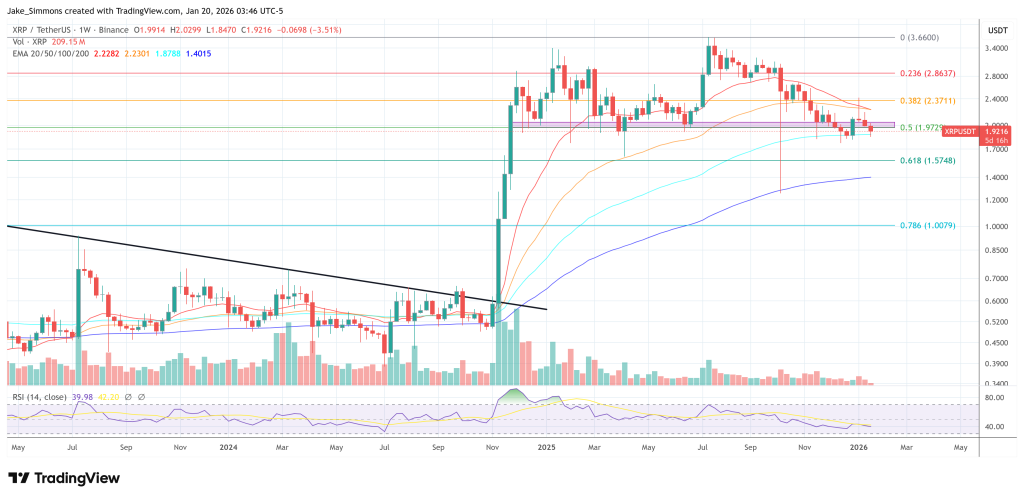
Featured picture created with DALL.E, chart from TradingView.com

Editorial Course of for bitcoinist is centered on delivering completely researched, correct, and unbiased content material. We uphold strict sourcing requirements, and every web page undergoes diligent evaluation by our crew of high know-how specialists and seasoned editors. This course of ensures the integrity, relevance, and worth of our content material for our readers.