
Miami’s historic theatres present a few of the most seen architectural remnants of its previous, however as town’s improvement priorities and identification have advanced, many of those establishments have fallen into disrepair. Ongoing restoration initiatives on the Coconut Grove Playhouse, Ace Theatre and Olympia Theater present three examples of how town and native communities have sought to protect them—or not.
The Coconut Grove Playhouse, designed by the architect Richard Kiehnel, opened on New Yr’s Day 1927 with the luxuries of air-conditioning and the biggest Wurlitzer organ within the US. Like many opulent venues on the time, the playhouse adopted native Jim Crow legal guidelines and solely welcomed white prospects. A number of blocks to the west, the way more modest Ace Theatre opened for Black audiences within the early Nineteen Thirties in an space often called Little Bahamas, the place a lot of Miami’s Caribbean founders lived. Within the Nineteen Fifties, the Ace was the one film theatre within the neighbourhood serving the Black neighborhood.
“As a result of there are such a lot of new folks shifting to Miami, these venues give them a possibility to study in regards to the place that they now name dwelling,” Christine Rupp, the director of Dade Heritage Belief, tells The Artwork Newspaper. “It’s not only a cultural expertise. It’s an academic expertise. And it’s a enjoyable expertise. In lots of instances, the theatres change into the final vestiges of the neighbourhoods that they have been as soon as serving.”
Premieres and movie stars
The Coconut Grove Playhouse finally moved away from movie, turning into one of many nation’s main venues for reside theatre from its heyday within the Nineteen Fifties till its closure in 2006. It hosted the US premiere of Ready for Godot in 1956 and the world premiere of the musical Fame in 1988. The playwright Edward Albee had a home across the nook and staged new work there, and world-renowned actors together with Liza Minnelli and Denzel Washington carried out on the playhouse. The theatre has remained empty ever because it closed nearly 20 years in the past. It was added to the Nationwide Register of Historic Locations (NRHP) in 2018.
The Coconut Grove Playhouse has been the topic of a number of restoration plans through the years. The newest of those includes razing 80% of the constructing and leaving simply the façade; demolition started in April 2025, regardless of public outcry. The plan has additionally been controversial for devoting many of the playhouse’s area to non-theatrical actions. When it first opened, the theatre had an auditorium that seated 1,150 folks. The present plan, envisioned by the Miami-based structure agency Arquitectonica, has scaled this down considerably, to only 300 seats. As well as, greater than 60% of what was previously efficiency area will change into leased business area.
The quickly altering neighbourhood of Coconut Grove has change into more and more costly in recent times, partially on account of intensive improvement initiatives designed by Arquitectonica, which can also be behind the close by Mr. C Residences. The structure agency, which designed Brickell Metropolis Centre and a slew of worldwide initiatives (together with the Westin New York resort in Occasions Sq.), has a tech-forward, Modernist design aesthetic that has remodeled a lot of Miami in its picture. Nevertheless, Arquitectonica has much less expertise with historic renovations. This made it an uncommon option to design the multimillion-dollar restoration of the Coconut Grove Playhouse. Whereas its plan for the playhouse maintains the unique façade, it provides a contemporary inside of tough rock and glass that mimics Miami’s altering city aesthetic over the previous 20 years.
The Ace Theatre is because of endure a modest rejuvenation
Tamanoeconomico through Wikimedia Commons
Demolition, not restoration
Opponents of Arquitectonica’s plan have argued that it constitutes a demolition, not the restoration for which the $20m in taxpayer cash allotted to the mission have been meant. Detractors advocated for the total restore of the theatre as an historic venue, however their appeals have been dismissed in courtroom. Shortly after demolition of the constructing started, native advocates have been outraged when a part of the façade collapsed as a result of mistaken elimination of a load-bearing wall. It stays to be seen whether or not the playhouse might be operational in time for its one centesimal anniversary and deliberate reopening in 2027.
In the meantime, on the Ace Theatre in West Grove—added to the NRHP in 2016—there are not any worldwide design corporations restoring the location to its former glory. In 2021 the theatre obtained a $400,000 grant from the Nationwide Park Service’s Historical past of Equal Rights programme for its restoration. The Ace’s mother-and-daughter house owners, Dorothy and Denise Wallace, are longtime residents of West Grove. Dorothy, now 96 years outdated—whose late husband purchased the constructing in 1979—was one among two Black girls who built-in the College of Miami’s College of Training in 1963. She hopes to see the Ace restored as a neighborhood area, just like the Historic Lyric Theatre in Miami’s Overtown neighbourhood, which is now dwelling to the Black Archives.
A few mile south-east of the Historic Lyric Theatre is downtown’s lavish Olympia Theater—one among tons of of “atmospheric theatres” designed by the architect John Eberson to make audiences really feel like they’re in an unique outside area. The Olympia, which replicates a Spanish backyard, was added to the NRHP in 1984. Just like the Coconut Grove Playhouse, it was among the many first air-conditioned buildings within the South when it opened as a “white-only” film palace in 1926. In its heyday, it hosted a spread of performers, from Elvis Presley to Etta James and B.B. King.
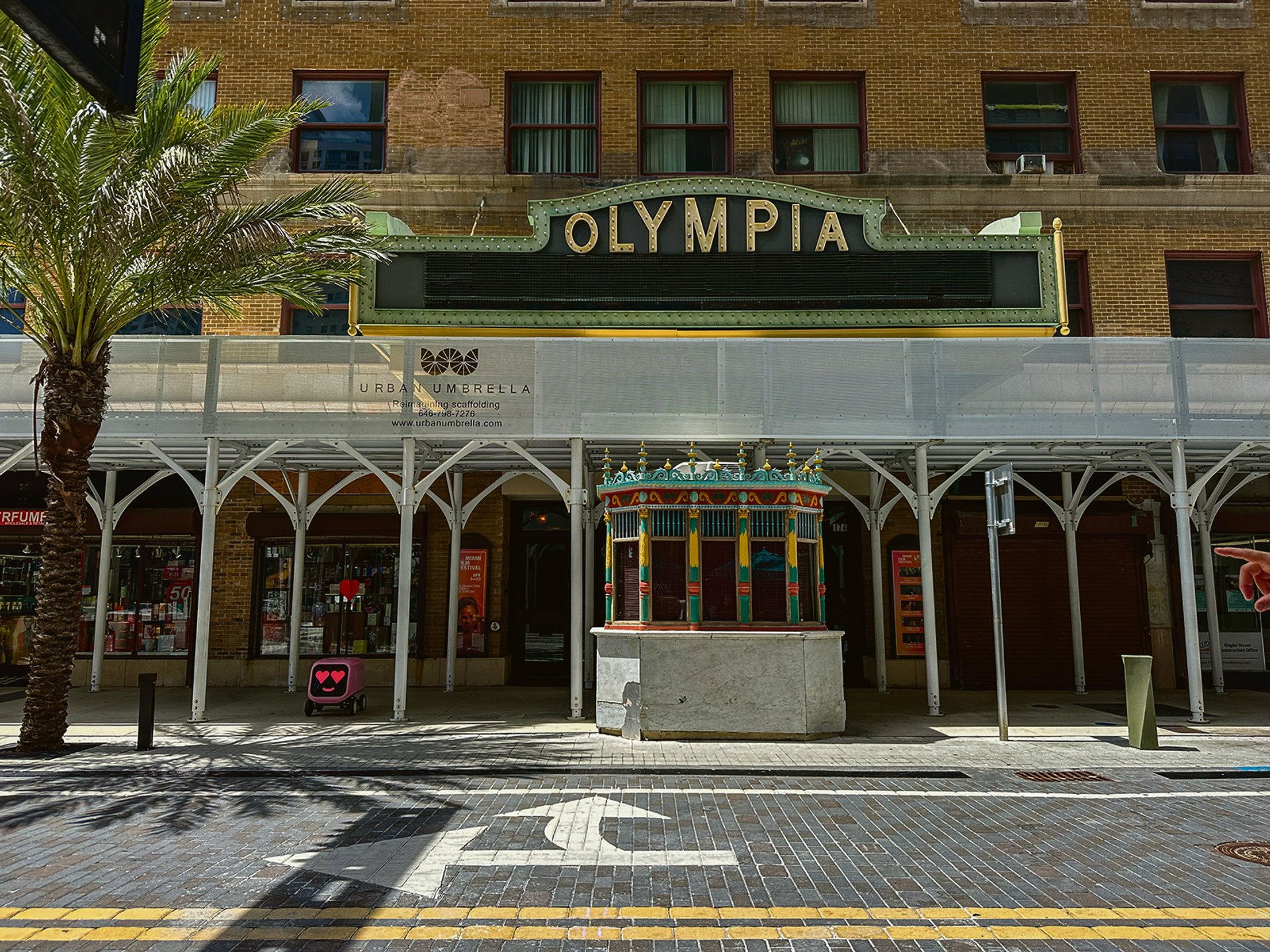
The Olympia Theater was constructed with an inside designed to make audiences really feel like they have been in a Spanish backyard; it’s now in a poor state of restore
Sierra Grace Manno
The constructing was later nearly demolished, however ended up being redesigned by the famed “Miami Fashionable” architect Morris Lapidus within the Nineteen Seventies. It underwent many modifications through the years, not too long ago serving as an essential website for the Miami Movie Competition. However in September 2025, Miami’s metropolis commissioners voted unanimously to promote the city-owned Olympia to Sports activities Management Arts Administration (Slam), a constitution faculty based by the rapper Pitbull. Slam purchased the constructing for a symbolic $10 and is now accountable for no less than $57m in repairs in addition to the price of extra renovations. Information of the sale has brought about a public outcry from arts advocates, who blame town for not doing extra to revitalise the historic theatre as a substitute of offloading the burden.
“There’s a clear pattern happening, the place privatisation and revenue is taking on established nonprofits and public belongings which have been deliberately uncared for,” says Sierra Grace Manno, an area artist and preservation activist who leads inventive neighborhood excursions of endangered constructions in Miami-Dade County. “The few historic buildings we’ve are caught in limbo till the general public is exhausted and slowly forgets about them or they’re too far gone to be saved. It might be foolish to assume that this hasn’t been deliberate out over many fee phrases. It’s actually no accident.” She says the shortage of a public request for proposals with respect to the Olympia as a possible violation of Florida’s Sunshine Legal guidelines, which require public discover earlier than the switch of land and items by the state.
Miami’s historic theatres as soon as served as anchor factors for communities in a few of its oldest neighbourhoods, which themselves have been gutted in current many years by improvement initiatives. The constructions’ present state of contentious disrepair represents each a mirrored image of Miami’s current municipal priorities and an opportunity for evolution as a metropolis. “It’s the present insurance policies and procedures that permit for that historical past to be erased,” Rupp says.