



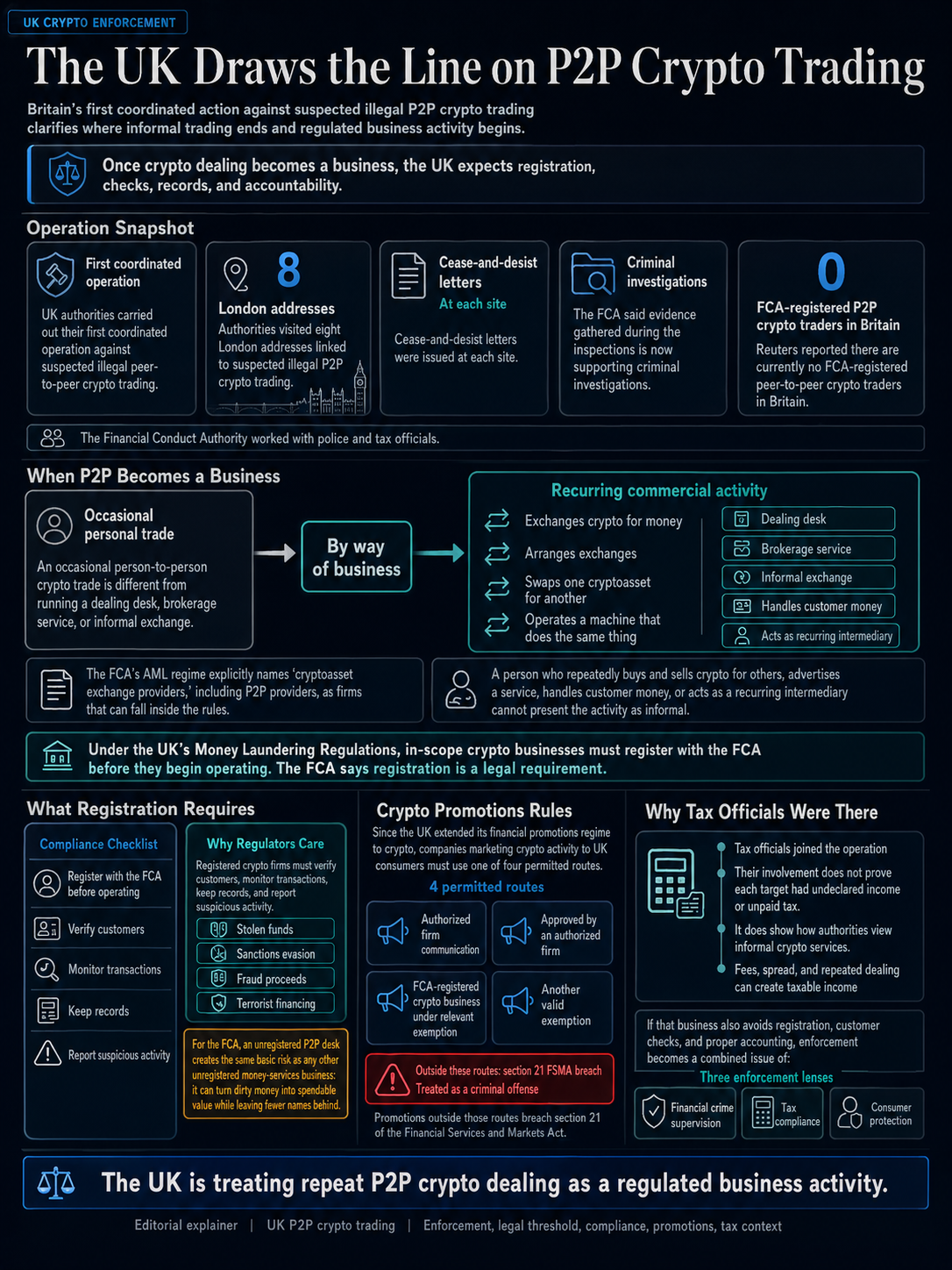
UK authorities have carried out their first coordinated operation in opposition to suspected unlawful peer-to-peer crypto buying and selling, sending a transparent and easy message to the market: as soon as an individual turns crypto dealing right into a enterprise, the state expects names, checks, data, and accountability.
The Monetary Conduct Authority (FCA) mentioned it labored with police and tax officers to go to eight London addresses linked to suspected unlawful p2p crypto buying and selling, issuing cease-and-desist letters at every website. Proof gathered through the inspections is now supporting felony investigations, in response to the regulator, whereas Reuters reported that there are at present no FCA-registered peer-to-peer crypto merchants in Britain.
The authorized facet is pretty straightforward to grasp. Within the UK, an occasional person-to-person crypto commerce isn’t the identical as working a dealing desk, brokerage service, or casual trade. The road is crossed when somebody commonly exchanges crypto for cash, arranges these exchanges, swaps one cryptoasset for one more, or operates a machine that does the identical factor “by the use of enterprise.”
The FCA’s anti-money-laundering regime explicitly names “cryptoasset trade suppliers,” together with p2p suppliers, as corporations that may fall inside the principles. An individual who repeatedly buys and sells crypto for others, advertises a service, handles buyer cash, or acts as a recurring middleman can’t describe the exercise as casual.
Underneath the UK’s Cash Laundering Laws, in-scope crypto companies should register with the FCA earlier than they start working, and the regulator says registration is a authorized requirement.

The reason being anti-money laundering. A registered crypto agency has to confirm clients, monitor transactions, hold data, and report suspicious exercise. These necessities are a part of the monetary system that makes it more durable for stolen funds, sanctions evasion, fraud proceeds, and terrorist financing to maneuver by way of apparently abnormal funds.
For the FCA, an unregistered peer-to-peer desk creates the identical primary danger as some other unregistered money-services enterprise: it may flip soiled cash into spendable worth whereas leaving fewer names behind.
There’s additionally the difficulty of promotions. For the reason that UK prolonged its monetary promotions regime to crypto, corporations advertising and marketing crypto exercise to UK shoppers should use considered one of 4 permitted routes.
These embody communication by a licensed agency, approval by a licensed agency, communication by an FCA-registered crypto enterprise beneath the related exemption, or one other legitimate exemption. Promotions outdoors these routes breach part 21 of the Monetary Providers and Markets Act and are handled as a felony offense.
Having tax officers concerned within the investigation simply makes it extra sophisticated. It doesn’t show that every goal had undeclared revenue or unpaid tax, nevertheless it exhibits how authorities see casual crypto companies.
A enterprise that takes charges, earns unfold, or generates beneficial properties by way of repeated dealing can create taxable revenue. If that enterprise additionally avoids registration, buyer checks, and clear accounting, enforcement turns into monetary crime supervision, tax compliance, and shopper safety wrapped into one operation.
The UK has already moved crypto contained in the perimeter
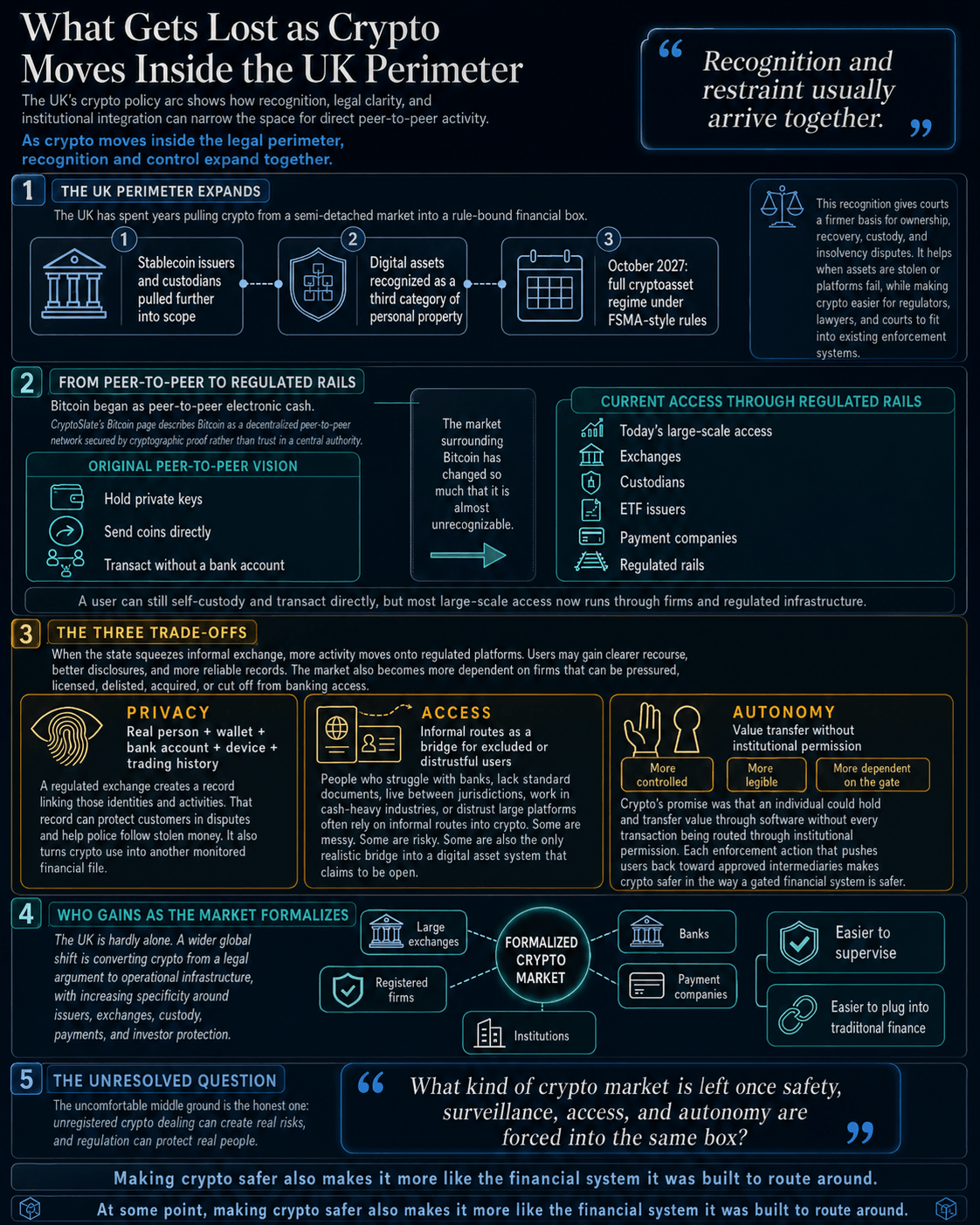
The UK has spent years pulling crypto from a semi-detached market right into a rule-bound monetary field. CryptoSlate has coated that course of in a number of levels, from the FCA’s expanded attain over stablecoin issuers and custodians to the UK Treasury’s October 2027 deadline for a full cryptoasset regime beneath FSMA-style guidelines.

The nation has additionally clarified that digital belongings might be handled as a 3rd class of private property, giving courts a firmer foundation for possession, restoration, custody, and insolvency disputes. That authorized recognition helps crypto house owners when belongings are stolen, or platforms fail, and makes crypto simpler for regulators, attorneys, and courts to suit into current enforcement techniques.
Recognition and restraint normally arrive collectively. The extra the state accepts crypto as property, market infrastructure, fee expertise, or collateral, the extra it needs to know who’s offering the service, who’s accountable when one thing breaks, and who’s checking whether or not felony cash is transferring by way of the system.
Bitcoin started as a peer-to-peer digital money system, and CryptoSlate’s Bitcoin web page nonetheless describes it as a decentralized peer-to-peer community secured by cryptographic proof quite than belief in a government.
But the market surrounding Bitcoin has modified a lot that it is nearly unrecognizable. A person can nonetheless maintain non-public keys, ship cash instantly, and transact and not using a checking account, however most large-scale entry now runs by way of exchanges, custodians, ETF issuers, fee corporations, and controlled rails.
That creates a authorized distinction that regulators can work with. Holding Bitcoin is one factor, however working a recurring enterprise serving to strangers purchase and promote it’s one other. Working an off-the-cuff service that substitutes for an trade whereas avoiding the controls that exchanges should comply with is strictly the form of exercise the FCA is designed to cease.
Seen that means, the raid is legally clear. The FCA isn’t inventing a brand new rule on the fly or regulating by way of enforcement. Its steerage states that corporations and sole practitioners offering in-scope crypto companies in a enterprise capability should register, and its registration web page particularly contains peer-to-peer suppliers within the class of cryptoasset trade suppliers.
The query we now have to ask now’s what will get misplaced when the regulation is enforced this manner.
The raid narrows the house the place crypto nonetheless appears like crypto
Peer-to-peer crypto has all the time carried two meanings directly. To regulators, it all the time appears to be like like a niche in surveillance: direct trades, fewer data, weaker id checks, and simpler motion between money, financial institution transfers, stablecoins, and wallets.
However to crypto-native customers, it is one of many final seen items of the unique design: two individuals exchanging worth with out asking a financial institution, dealer, app retailer, fee processor, or trade for permission.
An individual utilizing p2p markets to run an unlicensed trade isn’t defending monetary freedom. They’re utilizing the language of decentralization to keep away from obligations each different money-handling enterprise has to comply with, particularly within the UK.
Nonetheless, enforcement of this sort adjustments the form of the marketplace for individuals who by no means deliberate to commit a criminal offense. When the state squeezes casual trade, extra exercise strikes onto regulated platforms.
That offers customers clearer recourse, higher disclosures, and cleaner data. It additionally means extra id checks, extra transaction monitoring, extra account freezes, and extra dependence on corporations that may be pressured, licensed, delisted, acquired, or minimize off from banking entry.
The primary loss is privateness. A regulated trade creates a file that hyperlinks an actual individual to a pockets, a checking account, a tool, and a buying and selling historical past. That file can defend clients in disputes and assist police comply with stolen cash, however it may additionally flip their crypto use into one other monitored monetary file.
The second loss is entry. Individuals who wrestle with banks, lack normal paperwork, stay between jurisdictions, work in cash-heavy industries, or just mistrust massive platforms usually depend on casual routes into crypto. A few of these routes are messy, some are dangerous, and a few are additionally the one reasonable bridge right into a digital asset system that retains claiming to be open.
The third loss is autonomy. Crypto’s promise was by no means solely worth appreciation, though that’s what pulled most individuals in. It was the concept a person may maintain and switch worth by way of software program, with out each transaction being routed by way of institutional permission.
Every enforcement motion that pushes customers again towards accepted intermediaries makes crypto safer in the way in which a gated monetary system is safer: extra managed, extra legible, and extra depending on the gate.
The UK is hardly alone right here. CryptoSlate’s end-of-the-year evaluate of 2025 regulation described a world wherein main jurisdictions started changing crypto from a authorized argument to operational infrastructure, with guidelines on issuers, exchanges, custody, funds, and investor safety turning into extra particular. T
he FCA’s London operation suits that world route. Casual entry factors are being pulled towards the identical perimeter as centralized platforms.
Which will assist massive exchanges and registered corporations. It could additionally make life simpler for banks, fee corporations, and establishments that need crypto publicity with out casual counterparties sitting beside them. The market turns into simpler to oversee and simpler to plug into conventional finance.
It additionally turns into much less peer-to-peer in probably the most primary which means of the phrase.
The uncomfortable center floor is the sincere one. Unregistered crypto dealing can create actual dangers, and regulation can defend actual individuals.
On the similar time, a system that treats each repeat act of casual trade as a enterprise to be registered, monitored, and supervised leaves much less room for the form of direct monetary exercise that made crypto culturally highly effective within the first place.
The UK could also be proper on the regulation. It could even be proper on enforcement. The open concern is what sort of crypto market is left as soon as security, surveillance, entry, and autonomy are all pressured into the identical field.
Sooner or later, making crypto safer additionally makes it extra just like the monetary system it was constructed to route round.