


A White Home digital belongings official has slammed the normal banking sector’s continued opposition to the proposed stablecoin yield compromise within the CLARITY Act.
On April 17, Patrick Witt, the manager director of the White Home Presidential Advisory Committee on Digital Property, accused the monetary establishments of “greed or ignorance” resulting from their intensified lobbying efforts to dam yield-bearing stablecoins within the upcoming laws.
In keeping with him:
“It’s laborious to elucidate any additional lobbying by banks on this situation as motivated by something apart from greed or ignorance. Transfer on.”
US lawmakers make bipartisan sablecoin yield compromise for CLARITY Act
The unusually sharp rhetoric from the administration displays the widening rift between the White Home and Wall Avenue over the way forward for the $320 billion stablecoin market.
Over the previous 12 months, the White Home has made vital efforts to achieve a compromise between the banking business and the crypto sector. Nevertheless, all has confirmed abortive thus far.
The newest is the Tillis-Alsobrooks proposed bipartisan compromise, which might ban passive yield on stablecoin balances whereas persevering with to allow activity-based rewards.
Nevertheless, unnamed banking commerce associations reportedly argue that even this restricted framework poses a structural risk to the normal monetary system. Consequently, they’ve expanded their lobbying marketing campaign to focus on a number of senators on the Senate Banking Committee.
Notably, the bankers, by means of the American Bankers Affiliation, beforehand claimed that the stablecoin yield loophole within the CLARITY Act may set off as much as $6.6 trillion in deposit outflows.
Nevertheless, the banking business’s dire projections straight contradict White Home information.
A report from the Council of Financial Advisers concluded {that a} complete ban on stablecoin yield would impose a internet value of $800 million on shoppers. The report additionally argued that the “yield prohibition would do little or no to guard financial institution lending, whereas forgoing the buyer advantages of aggressive returns on stablecoin holdings.”
Nonetheless, the bankers have rejected these assertions, noting that:
“As yield-paying cost stablecoins develop, households and companies have stronger incentives to maneuver funds out of financial institution deposits and into stablecoins, except Congress prohibits yield.
Even when complete deposits within the banking system stay fixed, deposits might be reallocated away from smaller banks towards a smaller set of huge establishments, and the share of deposits tied up in stablecoin reserves will eat into general financial institution lending capability.”
Demand for yield-bearing stablecoin rises
The legislative gridlock happens towards a backdrop of fast market evolution, with stablecoin holders more and more looking for yield-bearing belongings.
In keeping with Messari information, the availability of yield-bearing stablecoins has grown 15 occasions quicker than the broader stablecoin market over the previous six months.
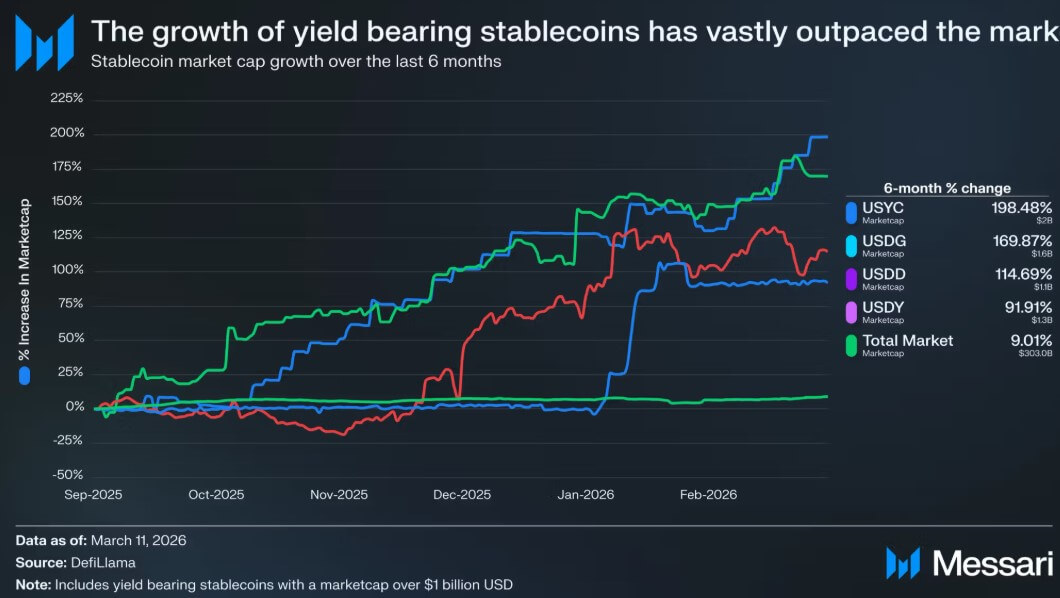
Because of the fast progress of the sector, time is working out for lawmakers to bridge the hole.
Sen. Thom Tillis advised reporters his crew remains to be going backwards and forwards on the compromise textual content, whereas Sen. Angela Alsobrooks indicated a launch is probably going subsequent week.
Nevertheless, if the Banking Committee fails to advance the invoice earlier than the top of April, political realities make passage in 2026 extremely unlikely. Actually, Sen. Cynthia Lummis has warned that the invoice won’t be handed till 2030 if a compromise is just not reached shortly.
In the meantime, the crypto sector maintains that capitulating to financial institution calls for will stifle home innovation.
Dan Spuller, govt vp of business affairs on the Blockchain Affiliation, stated:
“Our business is within the eleventh hour of negotiations and the push to drive every thing right into a financial institution mannequin is actual. Stablecoins are totally reserved cost instruments, not deposit-taking establishments. If we get this proper, America wins.”