


Iran’s Friday announcement that the Strait of Hormuz can be opened throughout the present ceasefire triggered one of many sharpest oil reversals of the 12 months.
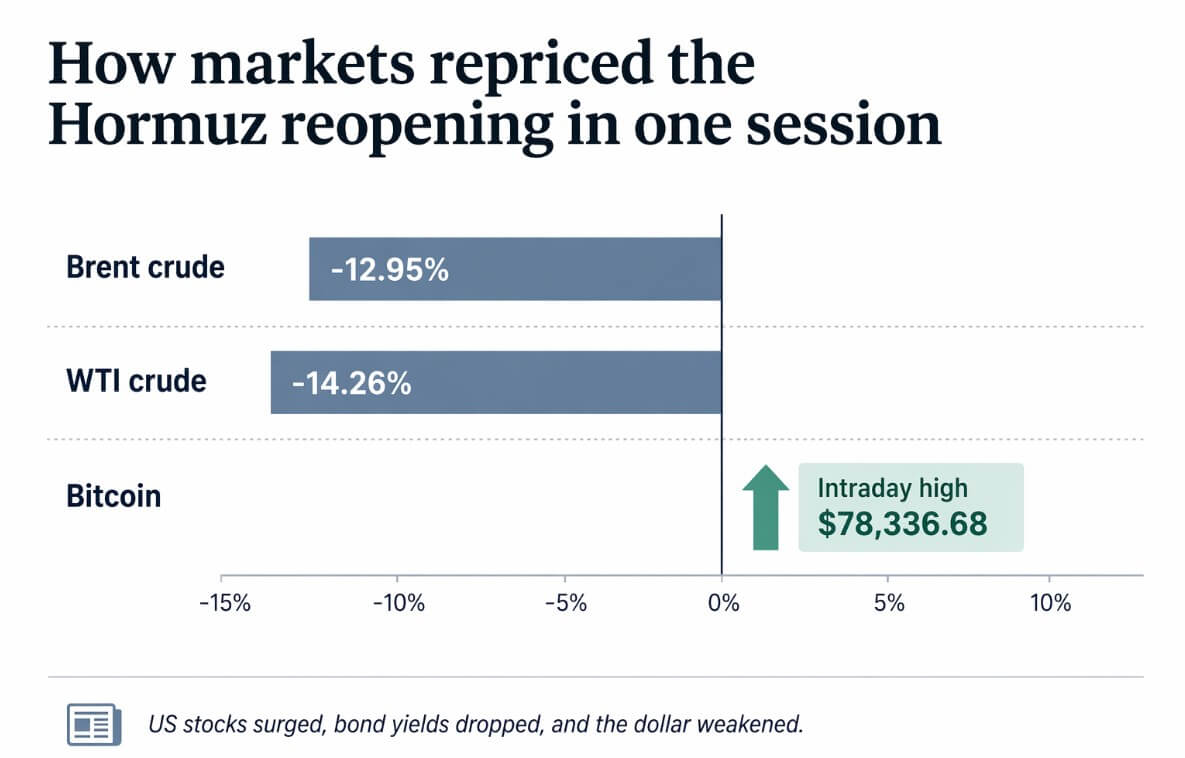
Brent crude fell 12.95% to $86.52, and WTI dropped 14.26% to $81.19, each their lowest ranges since Mar. 11 and the most important single-day declines since Apr. 8. US shares surged, bond yields dropped, the greenback weakened, and Bitcoin registered an intraday excessive of $78,336.
Merchants stripped the conflict premium they’d spent weeks layering into crude costs, and danger property repriced accordingly.
Yesterday, the Strait was opened on Iranian phrases. Industrial vessels required authorization from Iran’s Ports and Maritime Group and the IRGC and needed to transit by way of Iran-designated protected lanes, however the US blockade on Iranian delivery stays totally in place till a broader diplomatic settlement.
That window has already narrowed. As of Apr. 18, Iran stated it had closed the Strait once more after the US left its blockade in place, pushing the market again right into a countdown towards the Apr. 22 ceasefire deadline.
Solely eight oil and gasoline tankers moved throughout the reopening, underscoring how far the route stays from something resembling regular visitors.

Through the temporary window, the IMO was not capable of verify that the association met freedom-of-navigation requirements.
Delivery corporations had been ready for authorized and security readability earlier than resuming regular passage, and the US Navy said that the mine menace in elements of Hormuz shouldn’t be totally understood.
One Pakistani-flagged tanker carrying roughly 440,000 barrels of UAE crude exited the Gulf on Apr. 17, offering concrete information that passage was potential.
That temporary check by no means turned normalization. AP reported that solely eight oil and gasoline tankers transited throughout the quick reopening earlier than Iran reimposed restrictions, leaving Bitcoin with simply 4 days to see whether or not the ceasefire can produce actual delivery restoration earlier than Apr. 22.
Bitcoin is now caught between a market that priced reopening quick and a Strait that, as of Apr. 18, is closed once more forward of the Apr. 22 ceasefire deadline.
The arithmetic of concern
EIA information places common every day oil stream by way of the Strait at 20 million barrels in 2024, roughly 20% of worldwide petroleum liquids consumption, with 84% of crude and condensate and 83% of LNG flowing onward to Asian markets.
That’s the concrete threshold behind the market’s countdown: until visitors recovers earlier than Apr. 22, the route that carries about one-fifth of worldwide petroleum liquids stays functionally impaired.
For the reason that battle started, the conflict has knocked greater than 500 million barrels of crude and condensate out of the worldwide market, about $50 billion in misplaced output. Compared, international onshore crude inventories fell roughly 45 million barrels in April alone.
As just lately as Apr. 7, the EIA projected Brent averaging $115 within the second quarter. On Apr. 13, Morgan Stanley held Brent at $110 within the second quarter and $100 within the third quarter, modeling solely a gradual export restoration by way of October.
At $86.52, Brent sits materially beneath each main printed baseline from lower than two weeks in the past. The market has front-run a normalization path that neither the EIA nor Wall Avenue had priced.
That asymmetry shapes the monetary premium, which may dissipate a lot sooner. The IEA’s chief stated total Center East power output could take roughly two years to get better to pre-war ranges.
Why the reopening remains to be fragile
Iran’s operational message on Apr. 17 intently mirrors what its deputy international minister stated on Apr. 9, when ships may go with Iranian coordination however precise visitors ran beneath 10% of regular. That is roughly seven vessels per day versus the standard 140.
The diplomatic likelihood distribution modified whereas the passage guidelines stayed broadly the identical. A ten-day ceasefire and revived US-Iran diplomacy precipitated markets to reread the identical primary operational framework as de-escalation.
IssueCurrent statusWhy it mattersCommercial passageAllowed with Iranian coordinationPassage is feasible, however conditionalAuthorizationRequires Ports and Maritime Group + IRGC approvalShows Iranian management stays centralRoutingIran-designated protected lanesNot equal to regular freedom of navigationIMO standardNot but confirmedLegal/institutional ambiguity remainsMine riskStill not totally understoodPhysical danger nonetheless deters regular trafficInsurers / shippersWaiting for clarityOperational normalization has not happenedUS blockadeStill in forceBroader settlement nonetheless unresolvedTraffic levelBelow normalReopening shouldn’t be but routine
The Lebanon truce, which kinds a part of the diplomatic backdrop, nonetheless leaves Israeli navy presence in southern Lebanon and Hezbollah’s disarmament unresolved.
The blockade stays in power till a broader deal, and even when vessels start transferring, it takes roughly 21 days for ships to journey from the Gulf to Rotterdam, that means bodily provide reduction follows diplomatic headlines with a lag of weeks.
Insurance coverage premiums haven’t but normalized, no official authority has downgraded the mine warnings, and no main liner has publicly declared the route cleared.
The Bitcoin transmission channel
Bitcoin’s transfer right this moment runs by way of a selected macro chain. Oil fell, lowering the near-term inflation outlook and reorienting expectations across the Federal Reserve’s price path.
Merchants moved from pricing the Fed as sidelined till nicely into 2027 to pricing cuts by December 2026, a significant compression within the anticipated tightening window.
The March FOMC minutes had already flagged that increased crude costs had been anticipated to carry inflation in 2026 and {that a} extended Center East battle risked making pass-through to core inflation extra persistent.
When oil fell, that hawkish danger partially unwound. Bonds rallied, the greenback weakened, equities surged, and Bitcoin moved in keeping with the broader risk-on repricing.
Bitcoin has spent the previous a number of months behaving as a liquidity-sensitive danger asset whose trajectory tracks Fed expectations, tech sentiment, and the scale of the financial backdrop.
A sturdy de-escalation that retains oil costs falling lengthy sufficient to melt inflation and revive the Fed-cut story is a real macro tailwind for Bitcoin.
The paths forward
Whereas rhetoric has deteriorated shortly after the preliminary announcement, talks haven’t but formally failed, and the ceasefire nonetheless holds.
If that extends right into a broader US-Iran settlement, visitors resumes alongside lanes approaching internationally accepted requirements, mine warnings fade, and insurers soften their stance, the oil reduction may lengthen past right this moment’s worth.
The EIA already considered the market as oversupplied earlier than the battle started. A sturdy reopening may bleed out extra premium than most merchants presently anticipate, with Brent doubtlessly drifting into the mid-$70s to mid-$80s.
In that setup, Fed-cut expectations would transfer additional ahead, the greenback would keep below stress, and Bitcoin would have the cleanest macro tailwind accessible within the present cycle.
Citi’s 12-month bull case of $165,000 represents the outer envelope of what a sustained macro thaw of that magnitude may help.
ScenarioShipping realityBrent rangeFed implicationBitcoin implicationCeasefire holds, and delivery normalizesVessel counts rise, mine warnings fade, insurers easeMid-$70s to mid-$80sCuts pulled forwardStrongest macro tailwind for BTCCeasefire holds in identify, however normalization failsControlled lanes, weak ship counts, insurer warning persists$100–$115Higher-for-longer returnsBTC loses de-escalation premium
The extra underpriced adverse end result is a ceasefire that holds in identify however by no means produces delivery normalization.
Mine warnings persist, politically managed lanes preserve insurers cautious, tanker counts keep nicely beneath the 140-per-day threshold, and the operational actuality by no means matches the diplomatic headline.
In that situation, oil rebounds towards the $100-$115 vary that knowledgeable EIA and sell-side forecasts as just lately as final week.
The inflation reduction stalls earlier than reaching the Fed’s determination calculus, rate-cut expectations drift again out, and Bitcoin surrenders its de-escalation premium.
Citi’s recessionary draw back case of $58,000 marks the outer sure for Bitcoin re-entering a tighter-for-longer macro regime.
These two paths will first develop into seen in ship counts, insurer habits, and whether or not the US blockade language shifts over the subsequent 72 hours.
The ceasefire’s 10-day window offers this commerce a built-in expiry.
Factors to observe embody whether or not vessel counts transfer materially above Apr. 9 ranges, whether or not the IMO formally endorses the transit association, whether or not the US-Iran talks produce any revision to the blockade language, and whether or not Bitcoin continues to cost oil reduction as a Fed-relief narrative.