
In 1993, an opportunity encounter within the shops of Vienna’s Kunsthistorisches Museum between the Flemish artwork skilled Katlijne Van der Stighelen and an enormous portray depicting a Bacchanalian scene was step one within the rediscovery of the forgotten feminine Baroque painter Michaelina Wautier (round 1614-89).
The incident set in movement a seek for extra work by the Seventeenth-century artist, which ultimately culminated within the first main exhibition of her work on the Museum aan de Stroom in Antwerp in 2018. However that achievement was only the start of the story. Van der Stighelen instructed The Artwork Newspaper on the time that “given the truth that [Wautier] had a really lengthy life, I’m certain that any longer, many extra works will pop up”.
She was proper. Within the intervening years, a number of Wautier works have been unearthed, together with the masterly suite of work titled The 5 Senses (1650), identified beforehand solely by a black-and-white illustration in a 1975 public sale catalogue, in addition to Flower Garland with a Butterfly (1652). These will probably be among the many 25 works by Wautier happening present on the Royal Academy of Arts (RA) in London this month, introducing UK audiences to some of the vital artists of the Baroque interval, who till the twenty first century was barely an artwork historic footnote.
Wautier’s Flower Garland with a Butterfly (1652) Het Noordbrabants Museum, ‘s-Hertogenbosch; longterm mortgage of personal assortment; Photograph: Peter Cox
“She is genuinely a rediscovery of the final 20 or 30 years,” says the RA’s curator Julien Domercq. Little is thought in regards to the lifetime of Michaelina Wautier although. She is assumed to have been born in Mons round 1614 and later lived in Brussels. She had an older brother, Charles, who was additionally an artist and he’s recorded as having skilled overseas, presumably in Italy. It could be, due to this fact, that Wautier too skilled overseas, and it’s almost definitely she labored alongside Charles in his studio.
So little is thought about Wautier’s coaching and growth as an artist that it’s as if her first historical past portray seems in 1649 “seemingly out of nowhere”, writes Van der Stighelen within the catalogue. Moreover, Wautier was distinctive amongst identified feminine artists of the interval in that she painted all the principle genres, from portraits to still-lifes, historical past work to style scenes.
Throughout her lifetime Wautier appears to have had some success although. For instance, Archduke Leopold Wilhelm of Austria owned 4 of her works. However because the centuries handed following her demise in Brussels in 1689, she started to be forgotten. Like different artists of the Seventeenth century, “it appears that evidently her works exit of trend within the 18th century”, Domercq says. Moreover, “her works find yourself being attributed to an entire swathe of male painters”, he provides, even when, on a minimum of one event, her title was inscribed on the work.
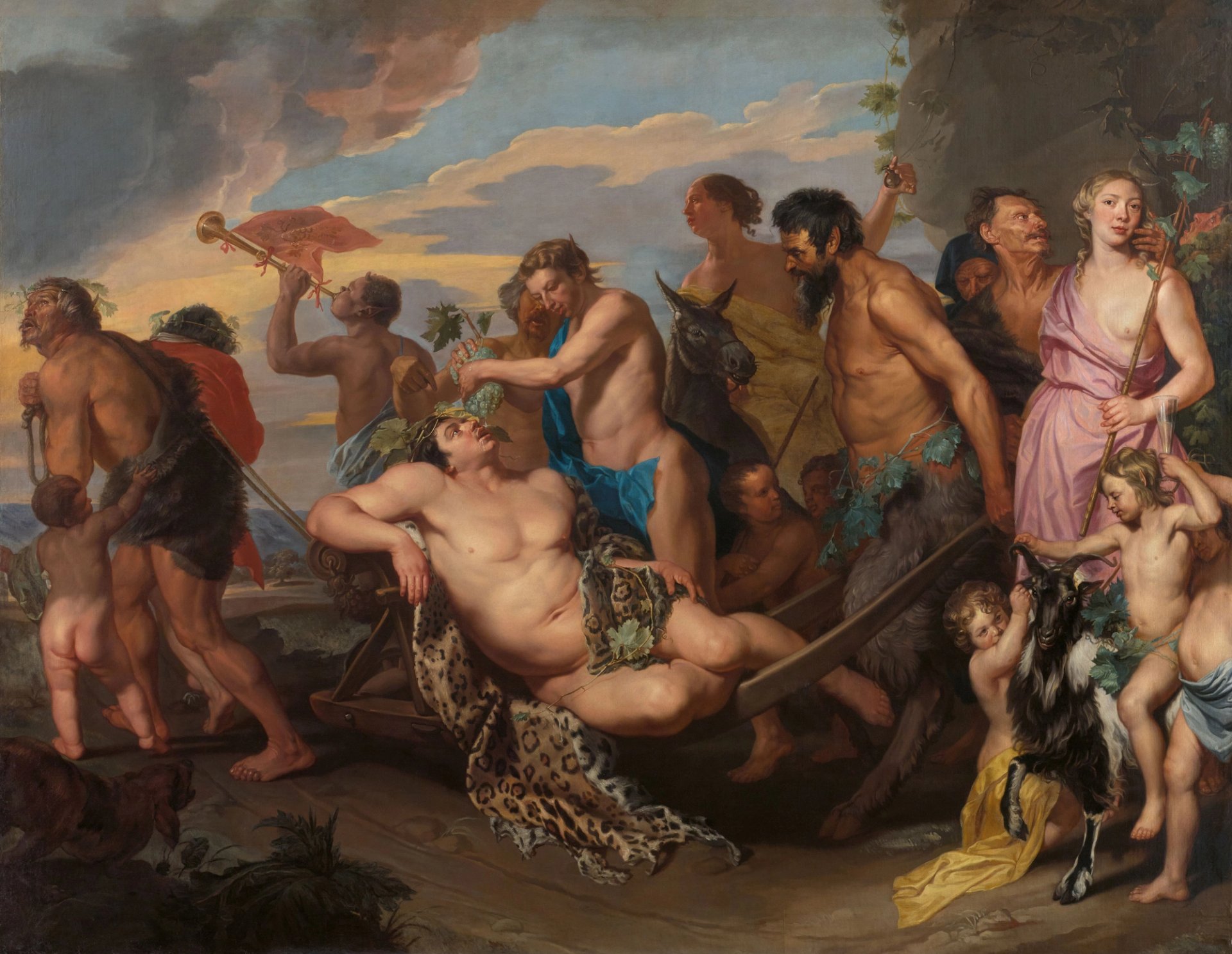
Wautier’s The Triumph of Bacchus (round 1655-59) Kunsthistorisches Museum Vienna; Photograph: © KHM-Museumsverband
The Triumph of Bacchus (round 1655-59)—the portray that first sparked Stighelen’s curiosity in Wautier—is a living proof. Through the years Wautier’s 3.5m-wide portray has variously been stated to be by the Faculty of Rubens, a duplicate after Rubens, by Luca Giordano or by Cornelis Schut. Within the early twentieth century, the curator of Flemish portray on the Kunsthistorisches Museum, Gustav Glück, stated: “even in our age of feminine emancipation, one would hardly want to ascribe this image, which exhibits a extremely vigorous, nearly coarse conception, to a girl’s hand.” The portray is on mortgage from the Kunsthistorisches, the place a model of this present debuted final 12 months.
Due to the shortage of archival materials, evaluation of Wautier’s portray approach has been particularly revealing. For instance, an in depth examine of The 5 Senses confirmed the presence of a really restricted variety of pigments within the work (which tallies with the colors on Wautier’s palette in Self-portrait, round 1650). Notably, there is no such thing as a color blue current, which was costly on the time, and but the headband of the boy enjoying the flute seems to be painted from that very color. It was as an alternative achieved “by creating an optical phantasm,” Domercq says. “By utilizing contrasting colors round [the scarf] she is ready to make a gray look blue.”
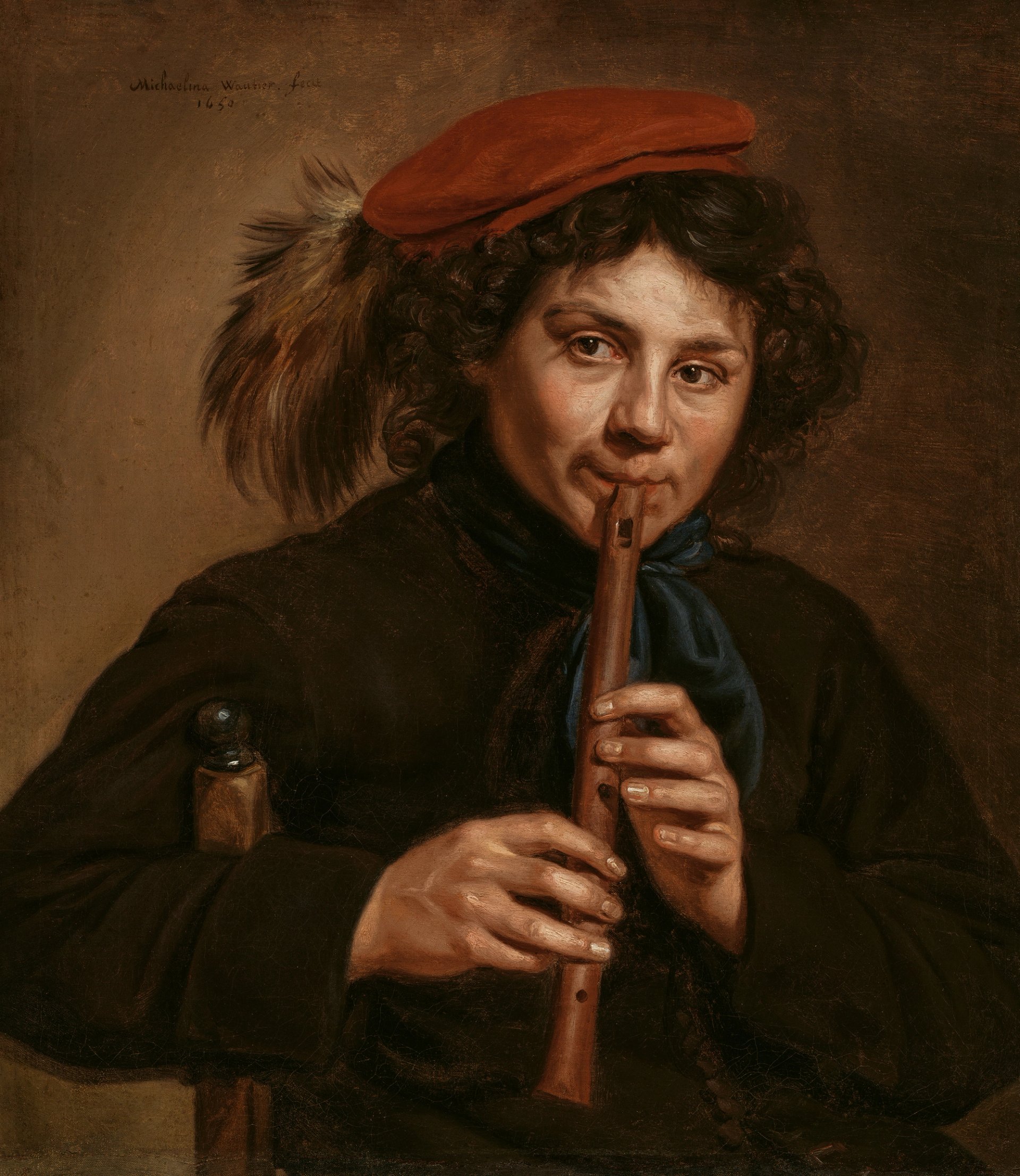
Wautier’s cautious use of contrasting colors makes the boy’s scarf in Listening to (1650), from the 5 Senses collection, seem like blue though there is no such thing as a blue pigment within the portray Rose-Marie and Eijk Van Otterloo Assortment
Wautier’s talent and dealing with of paint is what makes her stand out amongst her friends. “What defines her from numerous different individuals [of the period], together with her brother, is an actual virtuosic approach of portray,” Domercq says. Wautier had “a really free, very assured approach—like Rubens, like Van Dyck —of portray one thing in a short time however the brushwork is excellent, it expresses issues very clearly”.
Regardless of this being the most important present of Wautier’s work, Domercq sees it as one other “brick within the reconstruction of her oeuvre”. Wautier’s dated work span solely 16 years, from when she was in her late 20s to mid 40s, however she lived into her 70s, so there’s the chance that there are various extra work ready to be discovered. Domercq provides that the hope is that “{the catalogue} will probably be nearly out of date when the present ends, as a result of extra works will probably be found.”
• Michaelina Wautier, Royal Academy of Arts, London, 27 March-21 June