
Gold has fallen into bear-market territory after giving up its positive factors for the yr, at the same time as US spot Bitcoin exchange-traded funds (ETFs) continued to draw recent cash, pushing the 2 property onto sharply totally different paths.
Spot gold traded close to $4,388 an oz on March 23, in accordance with goldprice.org, down about 22% from its Jan. 29 file of $5,594.82. The decline accelerated after the most recent Center East battle started on Feb. 28. Since then, gold has dropped about 17%, reversing the advance that had carried it greater within the opening weeks of 2026.
On the identical time, institutional cash continued to circulation into the US spot Bitcoin ETF market. Knowledge from Farside Buyers present the funds took in about $2.42 billion of web inflows throughout the 4 calendar weeks ended March 20.
The divergence has drawn consideration throughout macro and digital-asset markets as a result of gold and Bitcoin are sometimes mentioned in comparable phrases in periods formed by inflation issues, forex dilution, and geopolitical stress.
Over the previous month, nevertheless, traders handled them very in a different way. Gold confronted liquidation stress as money demand rose and fee expectations stayed elevated. Bitcoin, by the ETF construction, continued to attract allocations by brokerage and advisory channels.
The transfer additionally stands out as a result of gold had entered 2026 with robust momentum. Its retreat now meets the extensively used market definition of a bear market: a decline of 20% or extra from a latest peak. Bitcoin, in contrast, has held up nicely sufficient to maintain ETF consumers engaged by the identical stretch of volatility.
Gold provides again early-year positive factors as charges keep excessive and traders elevate money
Gold’s decline has unfolded towards a macro backdrop that has change into much less supportive for property that have a tendency to learn from decrease yields and a softer greenback.
The Federal Reserve held rates of interest regular in March and projected the benchmark fee at 3.4% on the finish of 2026, whereas core private consumption expenditures inflation remained at 2.7%. That mixture strengthened the view that coverage could keep restrictive longer than traders anticipated earlier this yr.
For bullion, the impact is direct. Greater charges elevate the chance value of holding a non-yielding asset. A firmer greenback provides stress by making gold costlier for consumers utilizing different currencies.
These forces intensified as traders additionally sought money and liquidity after the Center East shock pressured a repricing of development, inflation, and power expectations.
Fund-flow knowledge captured the shift shortly. LSEG Lipper knowledge confirmed world gold and precious-metals funds posted about $5.19 billion in weekly web outflows by March 18, the most important weekly withdrawal since at the very least August 2018. In the identical week, cash market funds took in $32.57 billion.
That rotation suggests traders moved towards liquidity and away from positions that had benefited from earlier inflation and geopolitical hedging demand.
Gold’s decline, due to this fact, suits right into a broader portfolio adjustment by which preserving flexibility grew to become extra vital as markets reassessed the possible path of financial coverage and commodity costs.
The selloff additionally arrived after a interval by which gold’s long-term assist regarded agency. Central-bank demand had helped underpin the bullion market by 2025, and the reserve case remained intact as 2026 started.
The latest drop reveals how forcefully short-term macro circumstances can overwhelm that structural assist over a matter of weeks.
Extra fund knowledge level in the identical path. The biggest US gold-backed ETF, SPDR Gold Shares (GLD), recorded $7.07 billion in outflows in March, in accordance with market knowledge.
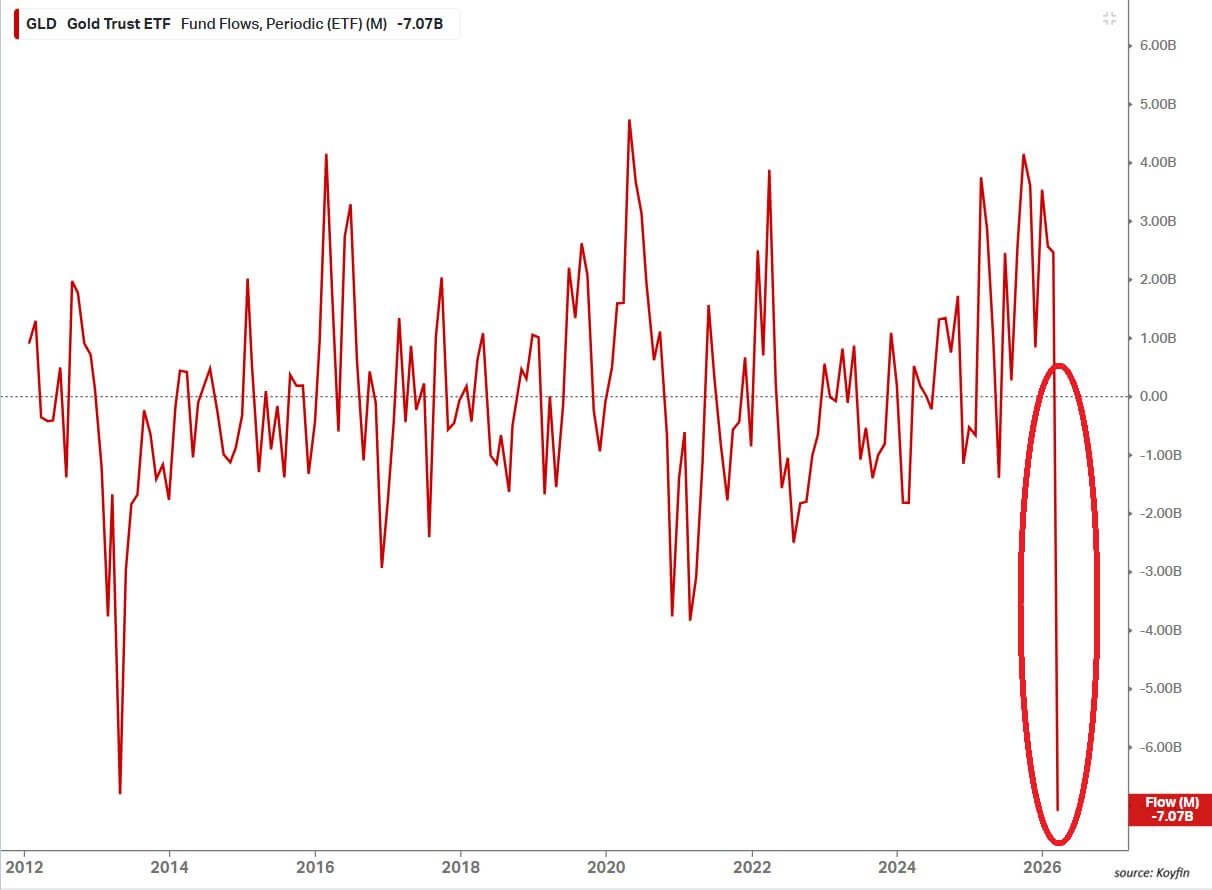
That exceeded the earlier month-to-month file withdrawal of $6.8 billion in April 2013. The tempo of redemption mirrored the pace of the reversal in investor positioning after gold’s run greater earlier within the yr.
By the usual utilized in monetary markets, a 22% decline from a January peak marks a transparent transition into bear-market territory.
Gold’s drop, due to this fact, represents greater than a routine pullback after a rally. It indicators a broad withdrawal from a commerce that had been supported by reserve accumulation, geopolitical hedging, and concern over inflation persistence.
Bitcoin funds lengthen their strongest influx streak of 2026
Whereas gold was dropping floor, US spot Bitcoin exchange-traded funds posted their strongest influx streak this yr.
Farside knowledge present the 12 US spot Bitcoin funds recorded 4 consecutive weeks of web inflows, with greater than $2 billion added throughout that interval. It’s the longest run of 2026 and the strongest since August and September 2025, when the funds absorbed greater than $3.8 billion.
CoinShares knowledge present an identical pattern globally. The agency mentioned Bitcoin exchange-traded merchandise have registered $1.5 billion in inflows thus far this month.
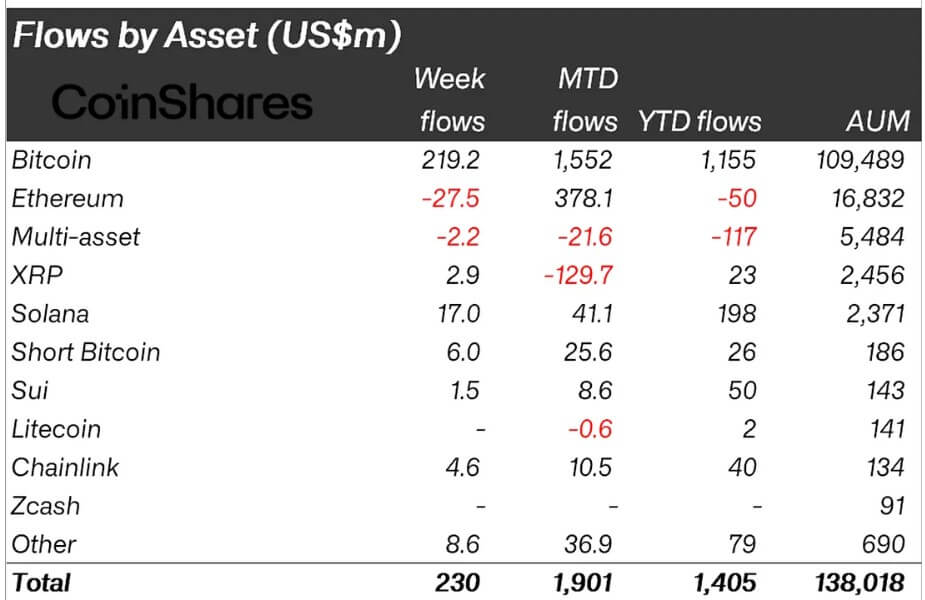
These inflows got here throughout a interval that included battle threat, shifting expectations for US rates of interest, and renewed volatility throughout commodities. Even in that backdrop, establishments continued to make use of the ETF wrapper so as to add or preserve Bitcoin publicity, whereas gold funds had been experiencing giant redemptions.
Final week, Bitwise mentioned Bitcoin and different main cryptoassets have outperformed US equities and gold because the starting of March.
The asset supervisor mentioned the transfer might level to the early levels of a rotation, whereas additionally cautioning that latest worth motion could replicate short-term volatility or remoted liquidity occasions. Bitwise added that gold has traditionally led Bitcoin by 4 to seven months.
State Avenue International Advisors outlined the volatility hole in its March gold monitor. Over a trailing 10-year interval, rolling 30-day volatility for Bitcoin averaged about 52.0, in contrast with 13.6 for gold.
From January 2016 by February 2026, Bitcoin recorded 30 months with losses larger than 8%, whereas gold recorded one such month, in accordance with the report.
These figures present the kind of publicity traders had been taking by Bitcoin ETFs. Consumers had been accepting wider swings and deeper drawdowns in return for entry to an asset some traders view as a hedge towards fiat dilution and coverage threat.
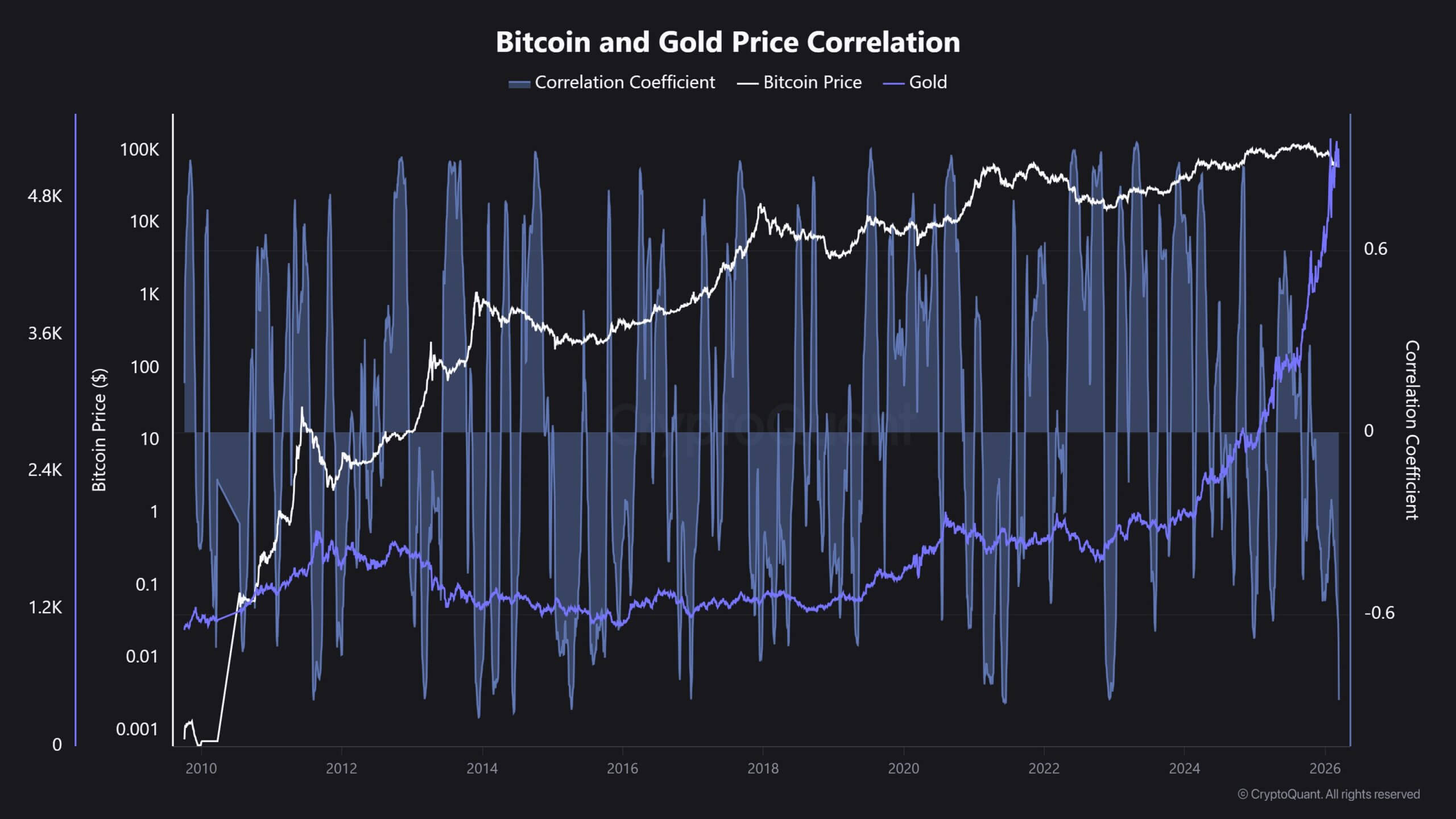
CryptoQuant knowledge additionally present how far the 2 property have diverged. The agency mentioned Bitcoin-to-gold correlation fell to minus 0.88, the bottom studying since November 2022, indicating the 2 property had been transferring in reverse instructions with uncommon pressure over the measured interval.
Oil and charges could form the following section
Gold’s longer-term assist has not disappeared, even after the March selloff, and that’s a part of what makes the present break up between gold and Bitcoin extra carefully watched.
The World Gold Council mentioned whole gold demand, together with over-the-counter exercise, exceeded 5,000 metric tons for the primary time in 2025. Gold ETF holdings rose by 801 tons final yr, and central banks purchased 863 tons. In February 2026 alone, bodily backed gold ETFs took in $5.3 billion globally.
These figures present official-sector shopping for and long-duration funding demand remained robust heading into this quarter.
The present drawdown, due to this fact, leaves traders balancing two forces: short-term macro stress from charges, greenback energy, and liquidity demand, and a structural reserve bid that remained in place by final yr and into early 2026.
Oil costs could play a central function in how that steadiness develops. A number of banks raised their 2026 Brent forecasts after the most recent Center East shock. Financial institution of America lifted its view to $77.50 a barrel, whereas Customary Chartered raised its forecast to $85.50. Financial institution of America additionally outlined an upside path towards $130 within the occasion of a protracted provide disruption.
Greater oil costs would feed inflation expectations and will maintain the Federal Reserve cautious for longer. That may have an effect on gold and Bitcoin by totally different channels.
Gold would proceed to face stress from elevated actual yields and greenback energy if coverage stays restrictive. Bitcoin would stay tied extra carefully to liquidity circumstances, institutional threat urge for food, and the willingness of ETF consumers to maintain including publicity by regulated merchandise.
For now, the clearest market sign is the break up itself. Gold, lengthy handled as a conventional store-of-value asset in periods of stress, has entered a bear market after falling greater than 20% from its January excessive. Bitcoin, an asset extra generally related to bigger worth swings, has continued to assemble ETF inflows by the identical interval.

