
Christie’s is to promote Indian work and calligraphy from the gathering of the Seattle-based couple Mary and Cheney Cowles in London on 28 April, for an estimated complete in extra of £1.5m.
The Cowles have been devoted collectors and sellers of East Asian artwork for greater than 4 a long time. Cheney opened the Crane Gallery, specialising in East Asian artwork, in 1975, and continued to run it till he retired in 2016. Notably, in 2019, the couple made a joint reward of 550 works of Japanese portray, calligraphy, and ceramics to the The Metropolitan Museum of Artwork, the Freer Sackler, and the Portland Artwork Museum. In 2023, they offered a collection of classical Chinese language furnishings at Bonhams New York.
The forthcoming Christie’s sale is dominated by Mughal work, courting from the sixteenth to mid-Nineteenth century. Estimates vary from the low hundreds, some provided with out reserve, as much as £180,000 for Ascetics Encamped Outdoors a Walled City, Haryana (round 1816), from the sought-after Fraser Album, a set of work depicting Nineteenth-century life in India, commissioned by the English civil servants William Fraser and his artist brother James Baillie Fraser. It was purchased by the Cowles in 1988 from the New York vendor Terence McInerney
Virgin Mary Standing in Prayer (1600)
Courtesy Christie’s
“The walled city might be Rania, on the outskirts of Delhi, which William Fraser visited fairly steadily as a result of he had a bibi [an Indian companion] known as Amiban who lived there, and with whom he had a variety of kids,” Plumbly says. Regardless of the location, she says, “it speaks to Frasers’ need to doc the world that they discovered themselves in. It is a spectacular portray, and one that ought to do properly.”
The sale displays the Cowles’s particular pockets of curiosity, for instance a collection of 4 works that incorporate European motifs and strategies throughout the reigns of the Emperors Akbar (r. 1556-1605) and Jahangir (r. 1605-27), who had a powerful curiosity in European artwork. Inspired to check European Renaissance works by Akbar, courtroom artists started to select and select European rules that fitted with Mughal aesthetics and concepts—to various success. This “Mughal Occidentalism” will be seen in a uncommon Mughal depiction of the Virgin Mary (1600, est. £30,000-£60,000); The Angel Raphael Greeting Tobias (round 1600, est. £30,000-£50,000), a well-liked topic for courtroom artists; an outline of a nursing Madonna (round 1605, est. £40,000-£60,000) ascribed to the prolific courtroom artist La’l, and a secular drawing of a girl on a bench (round 1610, est. £20,000-£30,000).
Islamic calligraphy is central to the Cowles’ assortment and the modest choice within the Christie’s sale is led by an early seventeenth century Mughal folio from the Brabourne-Ardeshir album, with the calligraphy signed Abdullah al-Husayni, and a portray on the reverse of a courtier holding a e-book ascribed to Manohar (est. £80,000-£120,000).
Final October, Christie’s set a brand new excessive for any classical Indian or Islamic portray at public sale, when Basawan’s A Household of Cheetahs in a Rocky Panorama (round 1575-80) offered for £10.2m with charges. It was a part of a single-owner sale dedicated to the gathering of Prince Sadruddin Aga Khan, which notched up £45.8m from 95 tons, many instances the £8m pre-sale estimate, essentially the most worthwhile sale of South Asian artwork ever.
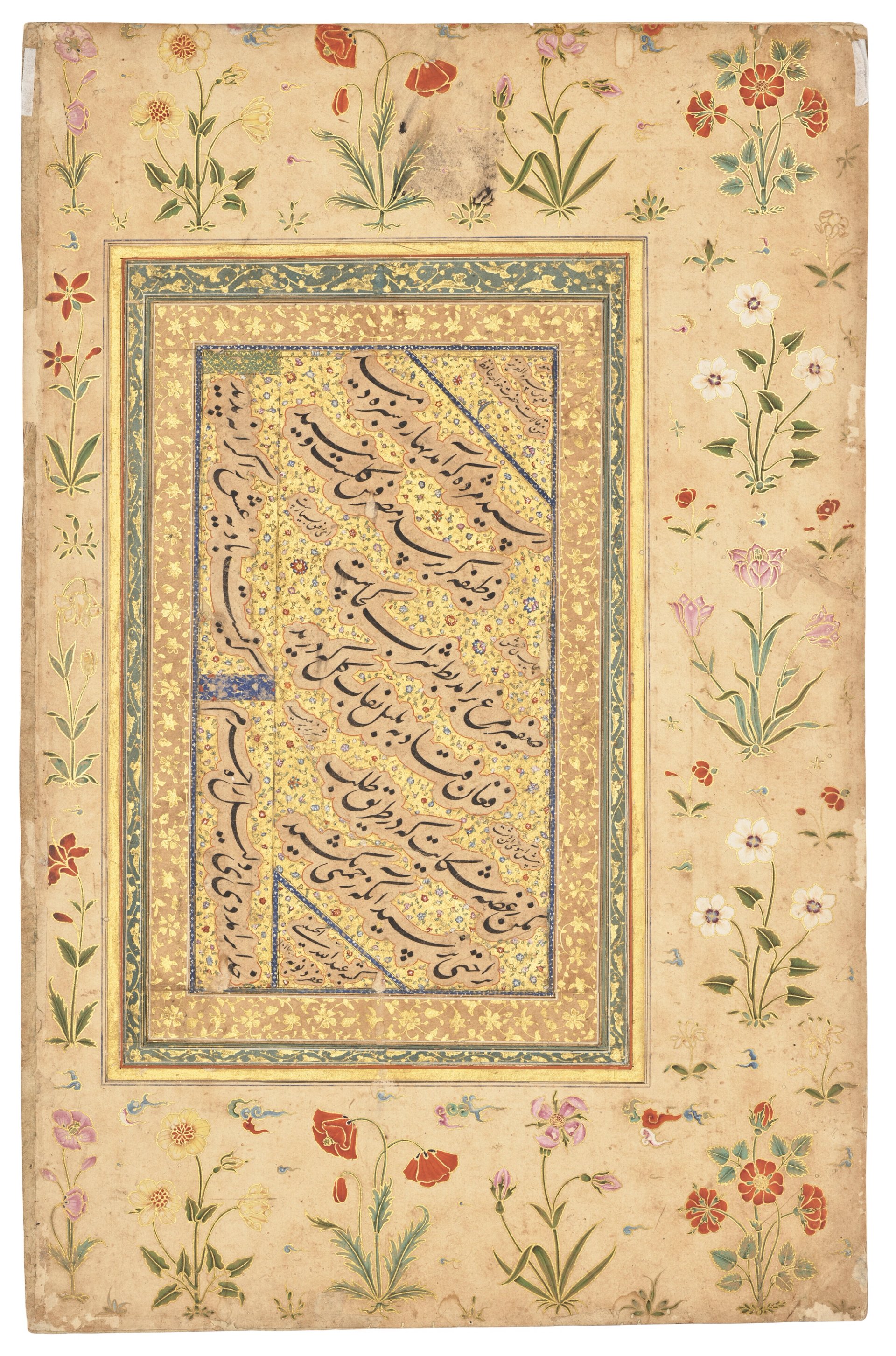
One facet of a folio from the Brabourne-Ardeshir album with calligraphy signed Abdullah al-Husayni, Mughal India
Courtesy Christie’s
The Cowles assortment might properly profit from the vigour of those outcomes, and Plumbly says that the Aga Khan sale “actually attracted new consumers to this explicit discipline.” She provides: “What it highlighted is that there’s a enormous demand for Indian work of museum high quality. Provenance is more and more necessary on this world and on this discipline—the Aga Khan assortment was great for that, however so is the Cowles’s as a result of they saved meticulous information.”
The number of classical Indian portray, from the Mughal to the Deccani, together with the breadth of worth factors can also be enticing to collectors, Plumbly says. “What we discovered with the Aga Khan sale was that it was the right likelihood for individuals who hadn’t dabbled within the discipline of classical portray earlier than to take action. A whole lot of consumers who usually accumulate modern Indian artwork have been, for the primary time, seeking to purchase earlier work, that match into their assortment in one other approach.”