It took a automobile, a motorbike and a donkey to get to Haiti’s Citadelle Laferrière, the most important fortress within the Western Hemisphere and a Unesco World Heritage Website since 1982. The journey to the majestic citadel was so time-consuming and the street so steep that we have been instructed at completely different elevation ranges to lean forwards or backwards. It took deep breaths and a whole lot of religion to lastly make it to our vacation spot.
En route, I noticed quite a few folks of various ages steadily strolling up the mountain—seven miles stretched earlier than them to get to the highest. That they had lengthy picket planks regular and balanced on their heads. Some had stopped on the facet of the street for a break. After we arrived, it was clear what these picket planks have been for: a serious conservation mission.
When the Haitian king Henri Christophe commissioned the fortress, constructed between 1805 and 1820, he ordered the development of many others prefer it throughout the northern coast of the newly impartial Caribbean nation. Making ready for future battles and in an effort to defend the nation from being reconquered, Jean-Jacques Dessalines (the revolutionary and first emperor of an impartial Haiti) entrusted the primary and solely Haitian king with this mission. Now, greater than 200 years later, development is underway once more.
I used to be engulfed within the shadow of the citadel. Our tour guides identified the tens of hundreds of iron cannon balls (for the greater than 300 cannons fabricated from bronze and iron) and the very best level that might permit the king to identify invaders coming by sea. It was a wise construction constructed to collect intelligence and to guard a brand new nation that emerged from the one profitable slave insurrection in historical past.
There are greater than 50,000 iron cannonballs nonetheless stacked neatly at Citadelle Laferrière Picture: Alan B Images, by way of Flickr
The native tour information Rose Beaulieu spoke concerning the looting after the king’s demise in 1820, the earthquake of 1842 that furthered the fortress’s destroy and quite a few different components which have brought on harm over the centuries.
The street we took was constructed by a authorities that noticed the worth of visiting the citadel. However on our manner, the younger males who led the donkey identified how they used to stand up to the construction: slim footpaths by means of the bushes. If you understand, you understand.
The information additionally identified the areas of the construction that have been walled off, closed as a result of there have been a number of plots all through the years involving theft and looting. Vacationers would take cannon balls, and through earthquakes or different instances of strife residents would seize a possibility to make quick money.
The planks delivered to the citadel have been a part of a preservation mission that has lasted 25 years, an effort to bolster the fortress towards earthquakes and supply higher customer entry. A few of the employees have been on the mission for the reason that starting; it’s scheduled for completion on the finish of this month.
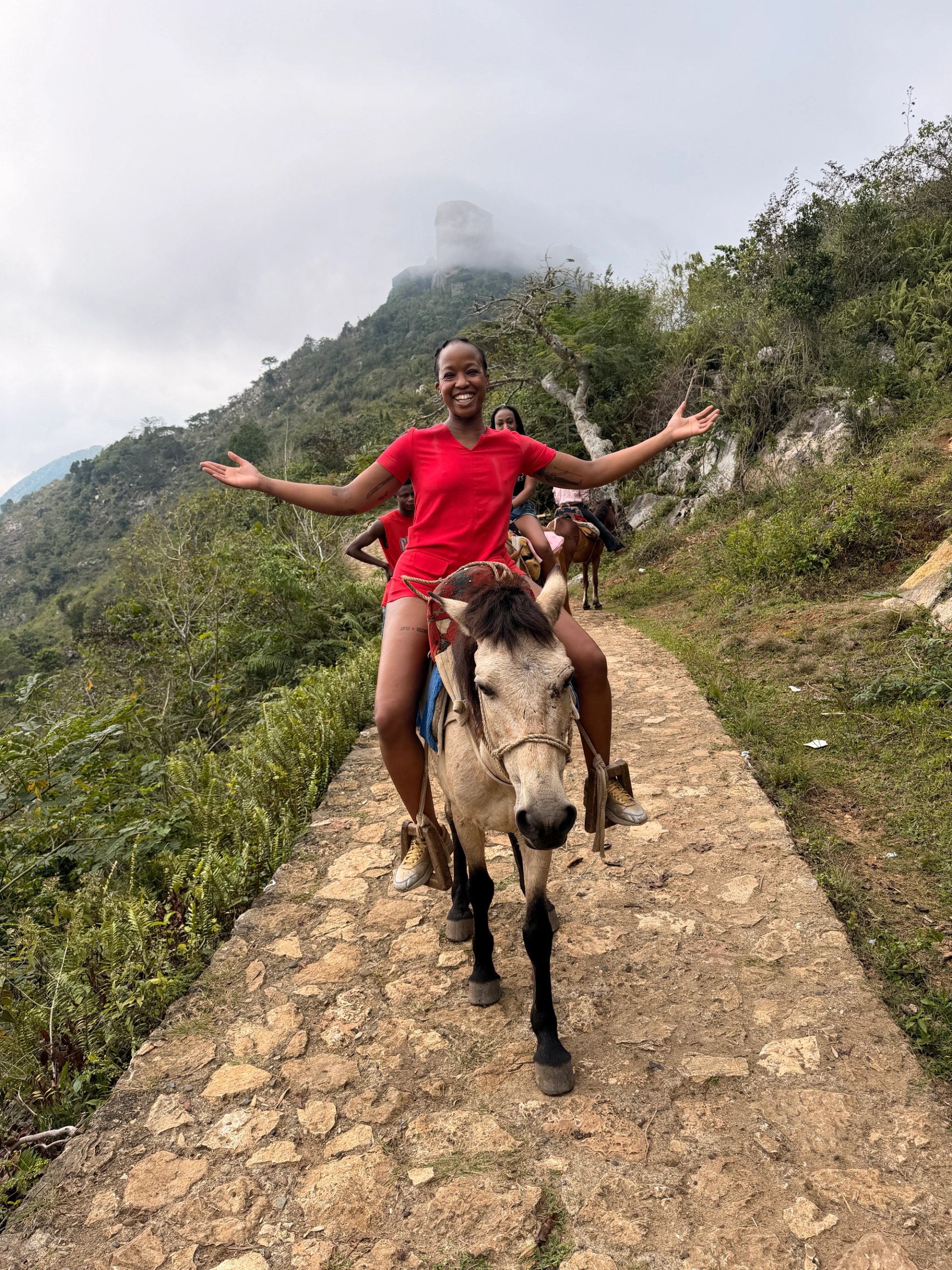
The writer driving her donkey on the trail resulting in Citadelle Laferrière Courtesy Ruth Jean-Marie
“Caring for heritage is a shared duty,” a spokesperson for the World Monuments Fund (WMF) tells The Artwork Newspaper. “Governments can play a big function, however communities, cultural establishments and companions all contribute to making sure that historic locations stay protected and valued for generations to return.”
The WMF’s work on the citadel has included waterproofing the construction. The organisation constructed a brand new roof from corrugated aluminium and spent greater than a 12 months planning the framing of the construction. Higher parts of the partitions, a few of them as much as 45 metres excessive, have been additionally reconstructed. The WMF additionally labored with Unesco to supply an skilled to share 19-century conservation methods with the native employees.
Once I visited, the Haitian Institute for the Safety of Nationwide Heritage (ISPAN) was nonetheless forging forward with development. Staff have been sealing cracks, engaged on a balcony and constructing small bridges. The picket helps—the planks I noticed introduced up one after the other—could be strengthened by injecting liquid cement into the citadel’s partitions. They may assist stop harm in future earthquakes.
Beaulieu commented on the renovations in Kreyol with an awe-inspired, assured tone. “The areas that have been closed off, for instance close to the Cross of David, there’s a really lovely renovation occurring that we didn’t even assume was going to occur,” she stated. “On this space the place they did the renovation, it’s a really massive house for guests. The renovations I’m seeing, there are extra potentialities and more room to go to. It’s an exquisite initiative. What’s taking place is critical and it’s being completed effectively. We’re watching to see if the remainder of the renovations will likely be comparable.”