
Bitcoin’s relationship with the Federal Reserve has gone by an actual transformation over the previous a number of years, and the shift now seems to be clear sufficient to deal with as a market construction growth somewhat than a passing commentary.
A well-recognized model of the thought reveals up as a fast market stat. Bitcoin typically falls after Fed conferences.
The longer historic file provides way more worth. Extending the evaluate again to the Federal Reserve’s 2020 FOMC schedule, and carrying it ahead by the present 2026 assembly calendar, reveals a market that moved from uneven post-FOMC reactions into a much more recognizable draw back bias throughout 2024, 2025, and the opening stretch of 2026.
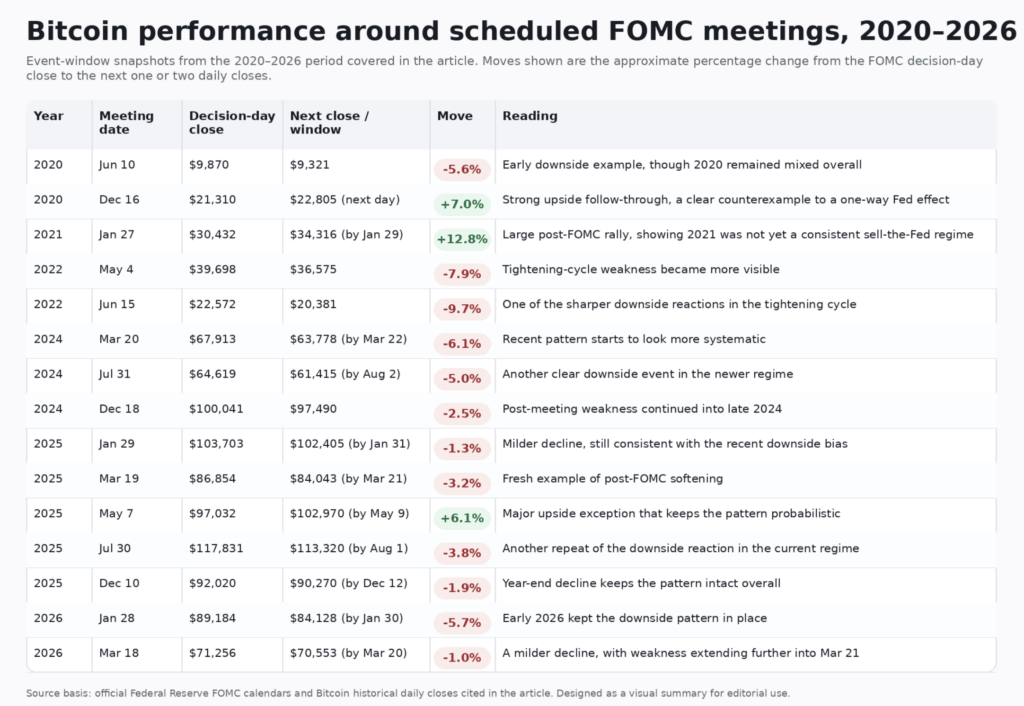
That evolution says an incredible deal about the place Bitcoin now sits within the world asset combine. Bitcoin trades inside the identical calendar gravity that shapes equities, charges, international trade, and broader threat sentiment. The Fed assembly itself has change into a part of the pricing rhythm.

The historical past of Bitcoin efficiency after Fed conferences
Beginning in 2020, the image seems to be unfastened, uneven, and extremely depending on the encompassing macro regime. Scheduled FOMC conferences didn’t produce a clear, repeatable draw back response in Bitcoin.
June 10, 2020 noticed a pointy drop into the next session, with BTC sliding from $9,870. to $9,321.
A dealer that transfer may simply construct a bearish Fed thesis. The remainder of the yr complicates that view. July 29 completed roughly flat to up. November 5 held close to highs. December 16 opened the door to a robust continuation greater, with Bitcoin climbing from $21,310 to $22,805 the subsequent day after which to $23,137 a day later.
That’s an early clue about what the lengthy pattern says. In Bitcoin’s earlier macro period, Fed conferences functioned as one catalyst amongst many.
Liquidity situations, pandemic-era coverage response, narrative momentum, and broad speculative urge for food all competed for management of worth motion. The FOMC calendar exerted affect, although it had not but set the rhythm of post-event positioning.
Transferring into 2021, the identical inconsistency stays. January 27 was adopted by a pointy rally, with BTC leaping from $30,432 to $34,316 by January 29. July 28 additionally pushed greater into month-end.
Different conferences leaned in the wrong way. March 17, April 28, June 16, November 3, and December 15 all softened over the subsequent one or two classes.
The result’s a combined yr the place Bitcoin clearly acknowledged the Fed as a macro occasion, whereas the response nonetheless lacked the type of persistent directional bias merchants search for when they need a calendar-based edge.
That distinction retains the historic framing sincere. Bitcoin has been macro-sensitive for years.

A scientific sell-the-Fed tendency emerged later
By 2022, the surroundings had modified. The Fed entered its aggressive tightening cycle, inflation dominated the macro dialog, and threat property throughout the board grew extra susceptible to coverage shocks.
Bitcoin mirrored that shift. Could 4 and June 15 produced notable draw back. BTC fell from $39,698 to $36,575 after the Could assembly. It dropped from $22,572 to $20,381 after June. These had been significant reactions, particularly within the context of a market already below strain from tighter liquidity and weaker threat urge for food.
Even then, the sample resisted any declare of complete consistency. January 26 and July 27 each delivered upside follow-through.
Bitcoin in 2022 behaved like an asset deeply uncovered to tightening situations, whereas nonetheless able to rallying round Fed occasions when positioning, expectations, and sentiment aligned the fitting manner.
The broader takeaway from 2022 sits within the route of journey. FOMC days had been turning into extra delicate and extra central to short-term threat administration.
Then got here 2023, one other yr that stored the transition seen with out totally locking it in place.
February 1 pale. March 22 and June 14 pushed greater. July 26 stayed near flat. November 1 pale. December 13 slipped into December 15. Once more, combined. Once more, macro sensitivity and not using a totally dependable one-way response.
Bitcoin nonetheless had room to shock in both route after a Fed choice. The occasion was vital. The directional sample remained open.

The true shift seems in 2024 and extends by 2025 and into 2026
That’s the place ‘promote the Fed’ begins trying extra like an rising conduct.
March 20, 2024 was adopted by one of many clearest examples. Bitcoin fell from $67,913 to $63,778 by March 22, a drop of roughly 6.1%. J
uly 31 delivered one other clear post-event decline, with BTC sliding from $64,619 to $61,415 by August 2, round 5.0%. June 12 additionally softened. December 18 moved decrease from $100,041 to $97,490 the subsequent day.
These reactions entice consideration as a result of they cluster. As soon as a market sees repeated draw back home windows after a recurring calendar occasion, contributors start to anticipate the sample.
Anticipation then adjustments positioning. Positioning then adjustments the occasion itself. That’s how a unfastened tendency turns right into a stronger regime function.
Then, in 2025, the sample pushed additional.
January 29 to January 31 drifted decrease from $103,703 to $102,405. March 19 to March 21 fell from $86,854 to $84,043, a roughly 3.2% lower.
June 18 to June 20 edged decrease. July 30 to August 1 dropped from $117,831 to $113,320, round 3.8%. September 17 to September 19 softened. October 29 to October 31 slipped. December 10 to December 12 moved down from $92,020 to $90,270.
Nevertheless, there was a serious upside exception in Could 2025.
Bitcoin rose from $97,032 on Could 7 to $102,970 by Could 9, a acquire of about 6.1%. That transfer deserves full inclusion as a result of a sample can change into systematic with out turning into common. In markets, these are very various things.
Within the current yr, two scheduled conferences have already taken place, on January 27 to twenty-eight and March 17 to 18, with the subsequent assembly set for April 28 to 29.
The January 2026 Bitcoin day by day shut knowledge reveals BTC at $89,184 on January 28 and $84,128 on January 30, a decline of about 5.7% throughout the subsequent two day by day closes.
March noticed BTC at $71,256 on March 18 and $70,553 on March 20, a decline of about 1%, with the drawdown extending to $68,734 by March 21.
Thus, the draw back bias that turned a lot clearer in 2024 and 2025 has due to this fact carried into 2026 as properly.
The present-year follow-through suggests the market continues to be treating Fed dates as moments to scale back publicity and de-risk post-event.
Bitcoin didn’t spend the complete 2020 to 2026 interval promoting off after Fed conferences. Throughout that stretch, Bitcoin turned more and more prone to deal with Fed conferences as de-risking occasions, with that conduct turning into a lot clearer throughout 2024, 2025, and early 2026.
That shift opens up a extra fascinating macro dialog
Bitcoin’s post-FOMC conduct now seems to be extra just like the conduct of an asset that has matured into the core threat advanced.
As institutional participation deepened and macro desks paid nearer consideration, Bitcoin moved nearer to the identical occasion framework that governs different extremely liquid property. FOMC days turned recognized portions on the calendar. Identified portions invite pre-positioning.
Pre-positioning invitations profit-taking, volatility compression forward of the occasion, and fast reductions in publicity as soon as the information passes.
In that sense, the route of the Fed choice turns into just one a part of the equation.
The date itself begins carrying weight. A closely anticipated occasion can create draw back strain even when the coverage end result lands near consensus.
As soon as a choice is priced, the market shifts consideration towards communication, tone, threat urge for food, and whether or not traders wish to carry publicity by the subsequent 24 to 48 hours.
Bitcoin’s latest conduct round Fed conferences means that calendar threat now performs a bigger function in that calculus.
There’s additionally a structural purpose this dynamic has endurance. The Federal Open Market Committee holds eight recurrently scheduled conferences every year. That creates one of many cleanest recurring catalysts in world markets, with intensive pre-positioning, intense cross-asset consideration, and a big data burst compressed right into a slender time window.
Bitcoin’s rising correlation to broader threat sentiment and its integration into institutional portfolios make that occasion window far more consequential than it was in earlier cycles.
The broader conclusion turns into clearer right here. Bitcoin’s rising sensitivity to FOMC dates factors to its continued evolution into an asset class that lives inside macro time.
Earlier in its life, Bitcoin typically moved to its personal rhythm, pushed by inner cycles, crypto-native catalysts, and bursts of narrative momentum that appeared disconnected from the financial calendar.
Right this moment, the calendar itself has change into a part of Bitcoin’s pricing structure.
Bitcoin’s growth comes with trade-offs
Larger institutional relevance brings higher publicity to the identical coverage expectations that form each main threat asset.
Deeper macro integration creates extra legitimacy, extra capital entry, and extra cross-market participation. It additionally creates recurring strain factors. Fed conferences now look like one in every of them.
For merchants, meaning post-FOMC weak spot deserves a spot on the playbook, particularly in a regime the place latest historical past has proven repeated draw back follow-through.
For traders and analysts, the larger takeaway sits one stage greater. Bitcoin’s response perform more and more resembles the response perform of a mature world asset, one which responds to coverage cadence, liquidity expectations, and the mechanics of event-driven positioning with rising consistency.
The market has moved past a world the place Bitcoin merely reacts to good or unhealthy Fed information in an easy manner. It now trades by a extra advanced macro lens, the place the occasion window itself can form conduct earlier than the market totally processes the choice.
That could be a signal of growth, integration, and that Bitcoin’s function within the monetary system continues to evolve.
The lengthy file strips out the temptation to overstate the sample as a everlasting historic rule. The latest file reveals why merchants more and more respect it anyway.
Put these collectively, and the conclusion is powerful: the sell-the-Fed dynamic has emerged as a significant function of Bitcoin’s present market construction, and its rise says as a lot about Bitcoin’s maturation because it does about any particular person Fed assembly.