
The work of the German artist Max Beckmann are straightforward to recognise however onerous to classify. Usually mislabelled as an Expressionist or else vaunted—to his chagrin—as a number one determine of the Weimar period’s New Objectivity motion, Beckmann (1884-1950) was a singular, wilful determine, with a pointy however ethereal palette and a crowd of recurring figures that included circus characters, road toughs and his personal menacing, mask-like face.
Nevertheless, an exhibition opening this month at Frankfurt’s Städel Museum stresses the significance of Beckmann not as a painter however as a draughtsman. The present, Beckmann, is a rarity for the artist, focusing solely on his drawing in 80 works, together with loans from main collections on each side of the Atlantic.
The exhibition is curated by Regina Freyberger, Stephan von Wiese and Hedda Finke. (This month, the latter two are publishing the primary two components of their three-volume catalogue raisonné of Beckmann’s drawings.) The present will start within the decade earlier than the First World Battle, when Beckmann was shaking off the residue of German Impressionism and absorbing the impression of French Submit-Impressionism; an early, soft-featured self-portrait from 1912, rendered in pencil, might be from the late nineteenth century.
Max Beckmann’s Girl with Candle (Quappi) (1928) Kunstmuseum Basel, Kupferstichkabinett; Picture: Kunstmuseum Basel
The struggle strongly affected Beckmann, along with his expertise as a medic resulting in an obvious breakdown in 1915. However the battle additionally made him a serious artist by wholly reconfiguring his artwork. His hard-edged signature fashion first emerged in his drawing, Freyberger says, and coincided with a brand new strategy to drawings usually, which by the Twenties had gone from portray research to autonomous artworks.
In 1925, Beckmann divorced his first spouse, the opera singer Minna Tube, and married the Bavarian-born Mathilde “Quappi” von Kaulbach, who grew to become his lasting muse. In a 1928 drawing of Quappi holding a candle, the artist vividly captures the impact of sunshine on her face and chest through the use of little greater than chalk and pencil on cardboard.
After the Nazis got here to energy, Beckmann was fired from his prestigious educating submit at Frankfurt’s artwork academy, resulting in his Dutch exile in 1937. The existential risk of the Thirties introduced color into his drawing, and The Homicide (1933), from the Städel’s personal necessary assortment, makes use of watercolour and gouache over charcoal to depict a tumultuous crime scene in eerie pastels.
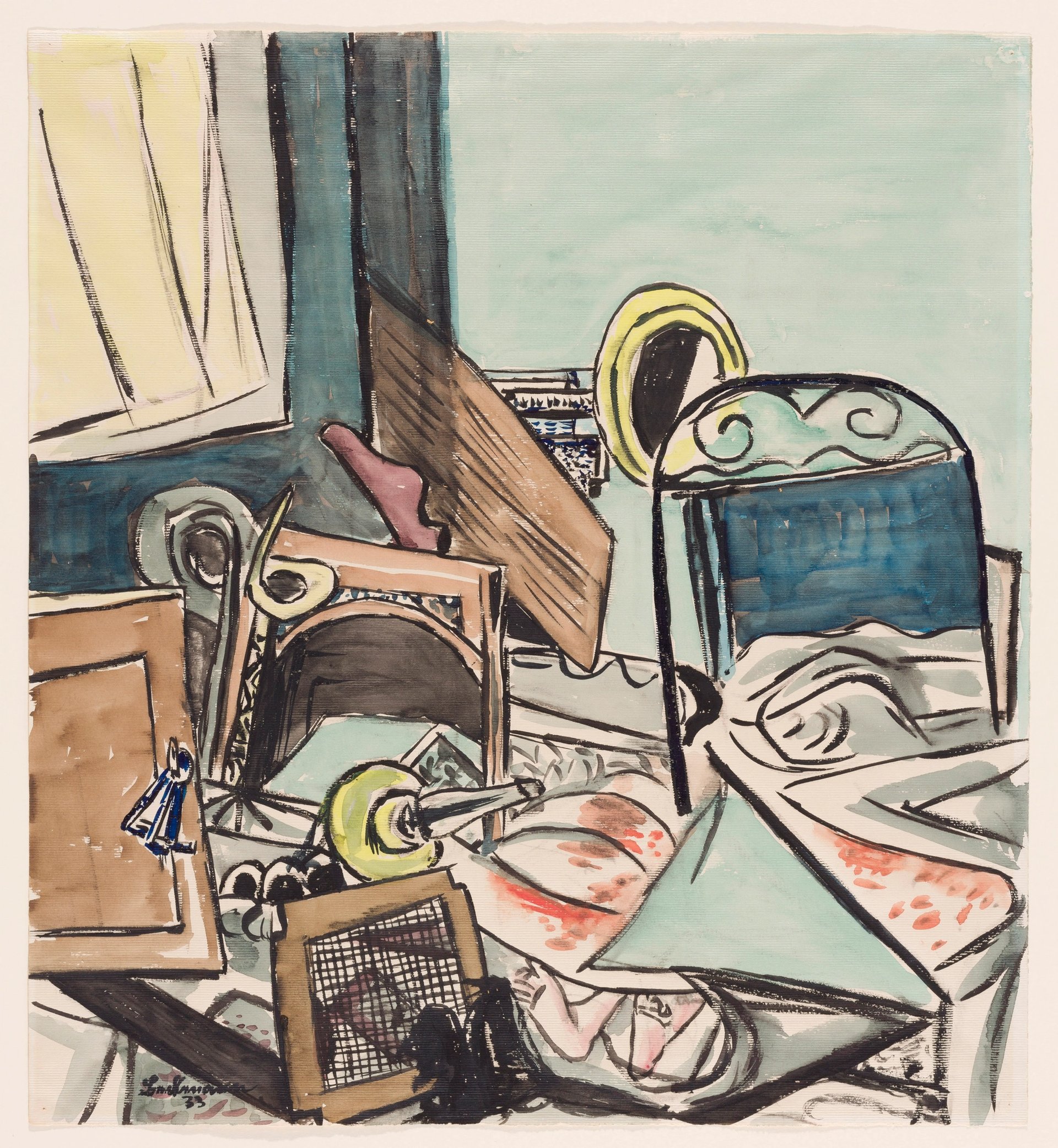
Max Beckmann’s The Homicide (1933) Städel Museum, Dauerleihgabe aus der Sammlung Karin & Rüdiger Volhard; Picture: Städel Museum, Frankfurt am Essential
The exhibition shall be wealthy in works from the final decade of Beckmann’s life, beginning with the pitch-dark struggle years cooped up in Nazi-occupied Amsterdam, adopted by a stressed however rousing post-war flip within the US. Two works from 1949, accomplished in Colorado, reveal the artist’s ambivalence in the direction of the rawness and weirdness of the New World. In Rodeo, a cowboy tossed into the air is a dire reimagining of a circus determine, whereas in a really late self-portrait Beckmann adopts an all-American cowboy hat—however holds up an Previous World emblem, within the type of a fish.
• Beckmann, Städel Museum, Frankfurt, 3 December-15 March 2026