The Argentine artist Adrián Villar Rojas unveiled a brand new sculpture in Switzerland this month, co-commissioned by the artwork programme of Swiss watch producer Audemars Piguet and the Aspen Artwork Museum. Now on view at Audemars Piguet’s headquarters in Le Brassus to mark the watchmaker’s one hundred and fiftieth anniversary, the work will journey to Aspen subsequent spring for Villar Rojas’s solo exhibition on the artwork museum.
The untitled piece is a part of Villar Rojas’s sequence The Language of the Enemy, by which he examines the fraught relationships between species amid international disaster. The sculpture contains a bronze Triceratops cranium displayed on a fluorescent-lit white plinth overlooking the Jura Mountains within the Vallée de Joux, the historic centre of Swiss horology.
“Language is know-how that we use to deal with and identify issues, a device we use to speak,” Villar Rojas mentioned on the sculpture’s unveiling. “However what occurs when language isn’t sufficient to speak with another person? Whenever you can’t deal with this ‘different’? I feel that’s when battle seems. When you’ll be able to’t actually talk, you begin to speculate on the intelligence of that individual. So language is the enemy.”
The form of Venus of Lespugue might be see on the right-side horn. Courtesy Audemars Piguet Up to date
Rising from one of many fossil’s horns is a rendering of the Venus of Lespugue, a prehistoric feminine figurine found in a French collapse 1922. Scientists date the statuette to as early as 26,000 years in the past, making it one of many oldest types of figurative artwork recognized. Villar Rojas imagines the component as a speculative collaboration between Neanderthals and early Homo sapiens—a logo of “the very first thing somebody wished to make to say one thing to another person that was not possible to say in some other method”, he says, prompting questions concerning the origins of inventive expression.
The sculpture was produced utilizing digital modelling, which allowed Villar Rojas and his group to design each aperture present in a pure fossil earlier than the bronze was forged at a neighborhood Swiss foundry.
That is the primary time Audemars Piguet Up to date, the corporate’s artwork programme, has premiered a fee at its headquarters. A number of workplaces within the spiral-shaped Musée Atelier Audemars Piguet overlook the set up. The model’s lengthy historical past with timekeeping aligns with Villar Rojas’s ongoing curiosity in “deep time”, an idea describing the huge, non-human scale of geological historical past.
In a lot of Villar Rojas’s earlier work, “deep time was all the time wanting for the time being after extinction—imagining these worlds of what occurs when it’s the tip of species, the tip of human life”, says Audrey Teichmann, co-art curator at Audemars Piguet Up to date. “Now we’re seeing a shift towards pre-history, towards the second earlier than arrival, and the hypothesis of an encounter.”
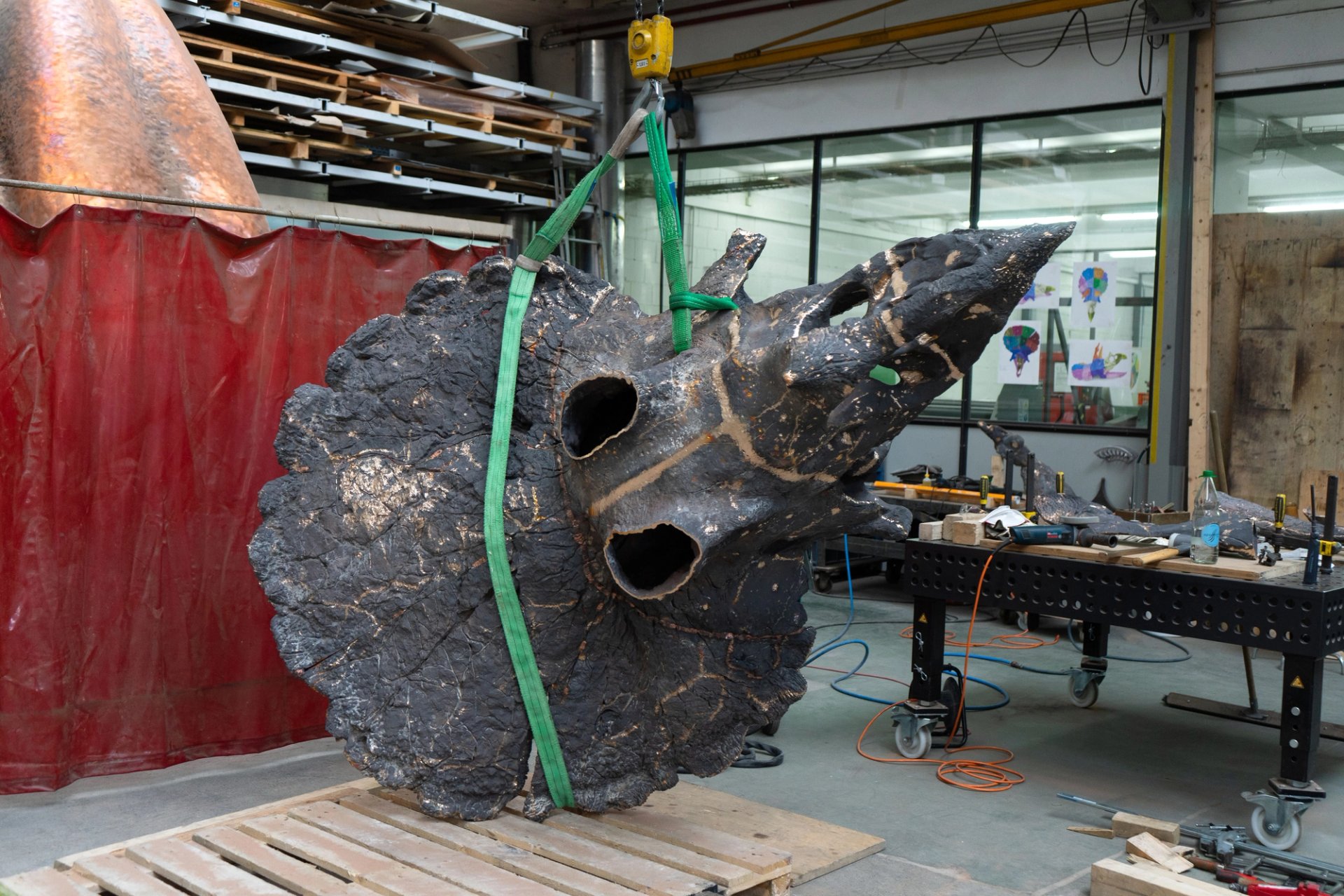
The work beneath development at a neighborhood foundry. Courtesy Audemars Piguet Up to date
Teichmann declined to reveal the undertaking’s finances. In accordance with Morgan Stanley, Audemars Piguet generated an estimated SFr2.4bn (virtually $3bn) in 2024. Subsequent summer time, the sculpture can be transported to the Aspen Artwork Museum, the place Villar Rojas will stage an exhibition throughout two flooring of the museum.
“This work can be a part of our exhibition in Aspen, nevertheless it’s additionally related to an entire sequence of exhibits Adrián has not too long ago offered—the Aichi Triennale, his exhibition in Seoul,” says Aspen Artwork Museum curator-at-large Claude Adjil. “For Adrián, exhibitions don’t start and finish; they kind our bodies of labor that bleed into each other.”
Guests to Villar Rojas’s takeover of a decommissioned main faculty in Seto Metropolis, Japan, through the Aichi Triennale noticed an early glimpse of the brand new sculpture, which appeared within the wallpaper protecting the constructing’s inside. Though the piece imagines a distant, prehistoric state of affairs, Villar Rojas sees parallels with modern anxieties.
“Take a look at what’s occurring in politics—I feel we should still be utilizing know-how and language in our political and socioeconomic relationships in ways in which haven’t saved tempo with the velocity of change,” he says. “I’ve frustration with our species and our lack of creativeness. We live via a particularly traumatic second.”
Adrián Villar Rojas: Untitled (The Language of the Enemy), till 31 March 2026, Audemars Piguet, Le Brassus, SwitzerlandAdrián Villar Rojas, 11 June-4 October 2026, Aspen Artwork Museum